From sizzling bacon in the kitchen to wildfire smoke in the sky, cooking and pollution release microscopic particles that affect humans' health, the air they breathe, and even weather and climate.
From sizzling bacon in the kitchen to wildfire smoke in the sky, cooking and pollution release microscopic particles that affect humans' health, the air they breathe, and even weather and climate.
New research from Virginia Tech is poised to upend how scientists think about the structure of these tiny airborne droplets and what that means for predictions around air quality, pollution spread, and climate models.
Yangyang Liu, a research scientist in civil and environmental engineering, and Peter Vikesland, the Pryor Professor of Engineering, found in lab studies that these particles have an outer “shell.” Inside the droplet, the chemistry may be acidic, but the outer surface can become strongly alkaline because fatty compounds, similar to oils released during cooking, form a coating around the particle. That coating creates tiny electric fields that change the chemistry at the surface and may play a major role in how pollution particles change after they’re released into the air.
Read More at: Virginia Tech
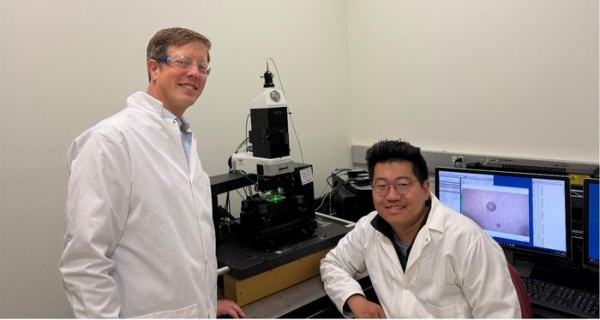
Peter Vikesland and Yangyang Liu often work with a confocal Raman microscopy system used to study the chemistry and properties of tiny aerosol droplets in the lab. (Photo Credit: Courtney Sakry for Virginia Tech)