Combining cold-atom experiments with ideas from stochastic thermodynamics and quantum gravity offers a new lab perspective on one of physics' oldest conundrums.
Combining cold-atom experiments with ideas from stochastic thermodynamics and quantum gravity offers a new lab perspective on one of physics' oldest conundrums.
A University of Birmingham scientist has built a 'mini universe' that takes a step towards answering one of science’s biggest questions: ‘what is time?’
Publishing his findings in Physical Review Research, Professor Giovanni Barontini shows how it is possible to measure the flow of time without using a clock at all. The new findings provide a scientific model where a version of time emerges from the experiment itself.
Some theories of physics, such as the Wheeler–DeWitt equation suggest that, at its deepest level, the universe has no built‑in time, but exists as a single, unchanging quantum state where particles exhibit both wave-like and particle-like properties. It treats the universe as a whole with no external clock, and any sense of time must emerge from internal relationships between parts.
Read More: University of Birmingham
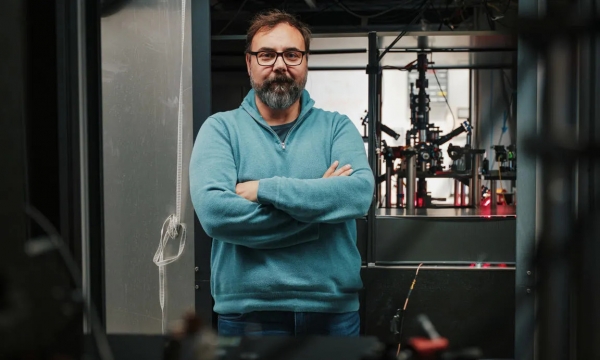
Image: Giovanni Barontini, Professor of Physics, at the University of Birmingham, with the apparatus to trap and cool rubidium atoms in the background. (Credit: University of Birmingham)