In recent years, marine heatwaves have been taking an ever-greater toll on the world’s oceans and their ecosystems.
In recent years, marine heatwaves have been taking an ever-greater toll on the world’s oceans and their ecosystems. Amplified by increasing global warming, these events are occurring more frequently and lasting longer. The Arctic is not spared from this trend either, as it is warming faster than any other region on our planet. However, due to local processes and conditions, marine heatwaves in the Arctic differ fundamentally from those in non-polar oceans. A recent study, led by the Alfred Wegener Institute, in the journal Communications Earth & Environment, summarizes how these events have developed over recent decades, what science knows about the driving forces behind them, and where there are still knowledge gaps to be filled.
Marine heatwaves are individual extreme events in which sea temperatures are unusually high for at least five days. They occur when strong solar radiation or warm air heats the water or when ocean currents carry unusually warm water in. “Recent studies show that the number of marine heatwaves has also increased significantly in the Arctic over the past few decades,” says Dr Marylou Athanase of the Alfred Wegener Institute, Helmholtz Centre for Polar and Marine Research (AWI). In a new publication, the climate researcher has summarized the current state of scientific knowledge, which highlights just how little these heat events are researched. Whilst research into marine heatwaves has seen a surge worldwide in recent years, studies in the Arctic remain scarce and there is no comprehensive assessment of their characteristics, drivers and impacts, or how these factors interact. “Yet in the Arctic, even a temporary rise in temperature of a fraction of a degree can have cascading impacts on the heat-sensitive polar ecosystem, and possible implications for the global climate system,” says Marylou Athanase.
Read More at: Alfred Wegener Institute, Helmholtz Centre for Polar and Marine Research
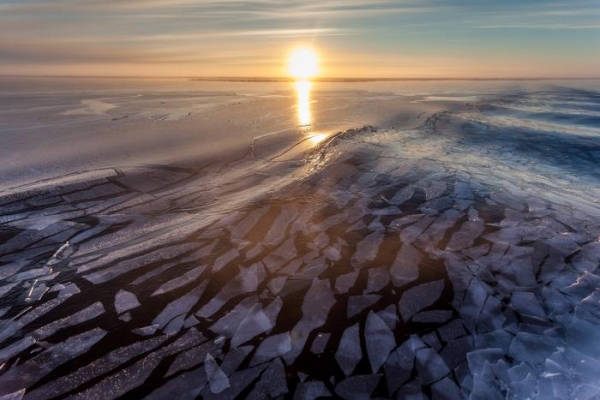
In the Arctic, there are climate processes that have no equivalent at lower latitudes: the presence of sea ice, altering heat fluxes between the atmosphere and the ocean, and the injection of ocean heat stored deep below the Arctic surface represent a previously overlooked class of influencing factors. (Photo Credit: Alfred-Wegener-Institut / Mario Hoppmann)