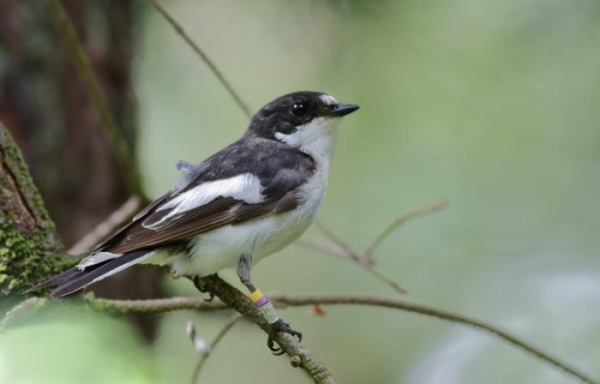
Migratory birds such as the pied flycatcher typically have wintering locations in Africa close to others from the same breeding population.
Migratory birds such as the pied flycatcher typically have wintering locations in Africa close to others from the same breeding population. That means that birds breeding in the Netherlands run into each other again in Africa, while, for instance, Spanish populations also end up close together. But how do they know where to go? A team of European researchers tracked the migration of pied flycatchers from eight different countries, but also performed a crucial intervention: what happens to the birds of Dutch eggs that are being raised by Swedish foster parents? The results of this study appeared in Science on June 25, and the researchers conclude that genes as well as environment influence where in Africa a bird finds its wintering spot.
Every fall, billions of migratory birds leave their breeding areas to go to a wintering location elsewhere. The pied flycatcher, a small bird of just 12 grams, travels some 3000 to 13,000 kilometres to Africa. There, he often settles in a place where also his peers from the same population reside: pied flycatchers from the Netherlands run into each other in Africa in winter, while their Spanish counterparts meet up elsewhere in Africa.
Why birds from a certain breeding area migrate to such a specific wintering location, is not yet understood. For some species of birds, it’s obvious: young geese learn from their parents, and several other species learn from their travel companions. But for song birds that travel alone and in the night, it is not yet clear why the end up at a specific spot.
Read More at: University of Groningen
Pied Flycatcher male with a light-level geolocator on its back, which had its migration tracked from the Dutch population, Aekingerzand, The Netherlands, 9 June 2027. Credits Richard Ubels (Photo Credit: Richard Ubels, University of Groningen)