

Worker bees are the first line of defense when it comes to removing contamination in honeybee colonies, but a queen has her ways, too.
Worker bees are the first line of defense when it comes to removing contamination in honeybee colonies, but a queen has her ways, too.
A honeybee queen facing chronic exposure to pesticides will take up that contamination and pass it along to her eggs, a process researchers call maternal offloading.
The findings, which document for the first time the extent a queen will go to survive, are published today in the journal Current Biology. Research was led by the University of California, Davis.
“In order to protect herself, the queen bee offloads these chemicals into her eggs to get rid of them,” said Sascha Nicklisch, the paper’s senior author and an associate professor in the Department of Environmental Toxicology. “No one has shown this in honeybees before.”
Read More: University of California - Davis
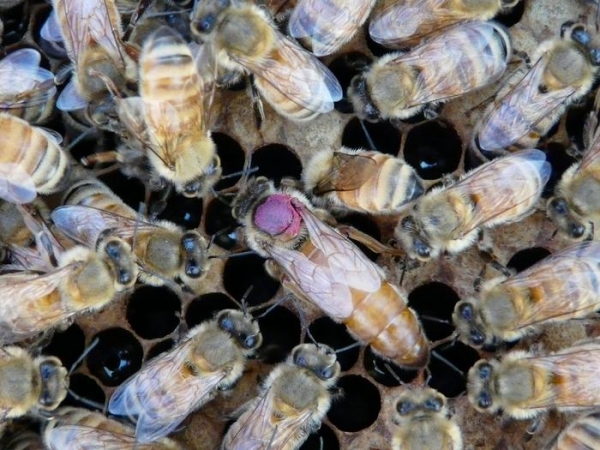
Image: A honeybee queen surrounded by her retinue, which is an ever-changing group of worker bees charged with her care, feeding and protection. The fuchsia spot is applied to queen bees to make her easier to identify. (Credit: Sascha Nicklisch/UC Davis)


