

The study published in Science helps us understand the role of this little-studied type of vegetation in climate change.
The study published in Science helps us understand the role of this little-studied type of vegetation in climate change. One percent of the tallest trees store more than half of the carbon in tropical forest ecosystems.
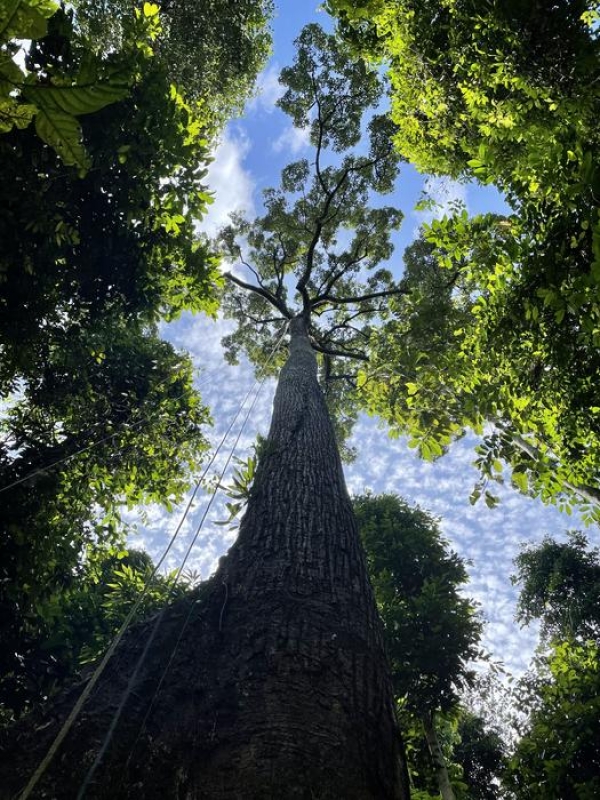
The giant trees of tropical forests are important allies in the fight against climate change due to their ability to store carbon, yet they are still poorly understood by science. However, a study published July 2, 2026, in the journal Science reveals a crucial survival mechanism: these trees, which exceed 70 meters in height, have no difficulty transporting water to their tops and are no more vulnerable than smaller trees.
They have developed internal adaptations that compensate for the challenges of transporting water to the highest branches. Furthermore, tests conducted during severe droughts showed that they did not experience a more pronounced decline in growth compared to smaller trees. This contradicts the hypothesis that very tall trees would be more susceptible to water stress.
To date, the scientific literature suggests that as trees grow taller, their ability to move water upward is impaired by the greater distance between roots and leaves, as well as by the effects of gravity. This would reduce photosynthesis, limit growth, and increase vulnerability to drought.
Read More: Fundação de Amparo à Pesquisa do Estado de São Paulo
Image: Bottom view of a 61-meter-tall dipterocarp with a tree climber at the top (Credit: Arne Scheire/University of Exeter)


