

The lava that buried entire neighborhoods during the 2018 Kīlauea eruption was composed of nearly 80% gas bubbles near its source.
The lava that buried entire neighborhoods during the 2018 Kīlauea eruption was composed of nearly 80% gas bubbles near its source. A recent study shows that those bubbles played a central role in controlling how fast and far the lava traveled, and that lava flow models need to account for bubbles to more accurately forecast where lava will stop.
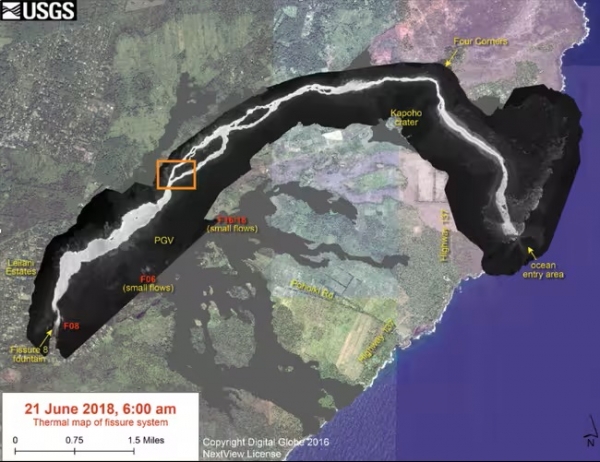
One of Hawaii’s most destructive volcanic events in two centuries, the eruption lasted from May to September 2018, covering 13.7 square miles (35.5 sq. km)—an area more than half the size of Manhattan—and destroying more than 700 structures. The most prolific lava source was fissure 8, known as Ahu’ailā’au, which produced a fast-moving, river-like flow that reached the coast in five days.
The study, published in the Journal of Volcanology and Geothermal Research, draws on more than 200 drone videos, lava samples and numerical modeling to track how the fissure 8 flow changed in speed, internal makeup and viscosity as it traveled eight miles (13 kilometers) to the ocean. By treating lava as a mixture of liquid rock, gas bubbles and crystals, the study reveals how interactions among those components shaped the flow’s behavior.
Read More at: Columbia Climate School
Map of the Ahu’ailā’au Cone fissure 8 flow field. (Photo Credit: US Geological Survey)


