

A new airborne imaging approach can reliably detect unexploded weapons that lay in shallow coastal waters and remain an ongoing hazard to public safety, marine ecosystems, and infrastructure worldwide.
Anew airborne imaging approach can reliably detect unexploded weapons that lay in shallow coastal waters and remain an ongoing hazard to public safety, marine ecosystems, and infrastructure worldwide. By combining advanced multispectral sensing with artificial intelligence, the researchers were able to identify underwater munitions with high confidence, even when they are partially hidden by sediment, biological growth, or debris.
Scientists at the University of Miami Rosenstiel School of Marine, Atmospheric, and Earth Science developed and tested the approach, with findings published in the April issue of Frontiers in Marine Science. The study demonstrates that integrating NASA underwater imaging technologies with machine learning enhances detection accuracy while reducing false positives in complex marine environments.
“Unexploded ordnance in shallow waters remains a serious global challenge,” said Ved Chirayath, Vetlesen Endowed Chair of Earth Sciences in the Department of Ocean Sciences, the study’s lead author. “Our results demonstrate a scalable, airborne solution that can help improve detection accuracy and support safer coastal environments."
Read More at: University of Miami Rosenstiel School
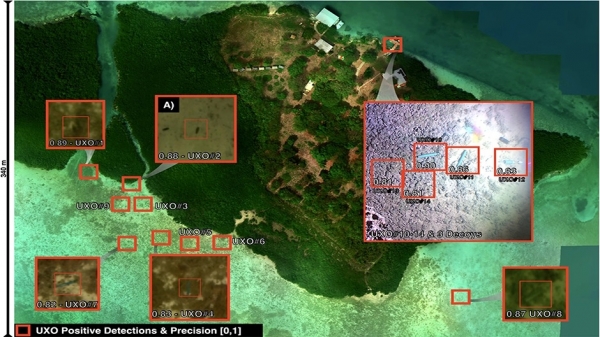
UXO positive detections at Broad Key Research Station and detection precision. All UXO targets were successfully detected in the Fluid Lensing RGB image. All locations and detections are highlighted in red boxes with associated F1 (Dice) precision score in white. Note that in panel A, the black nipple dummy target was not detected as UXO, and several highlighted examples show detection against complex backgrounds. (UXO, unexploded ordnance) (Photo Credit: Aircraft Center for Earth Studies)


