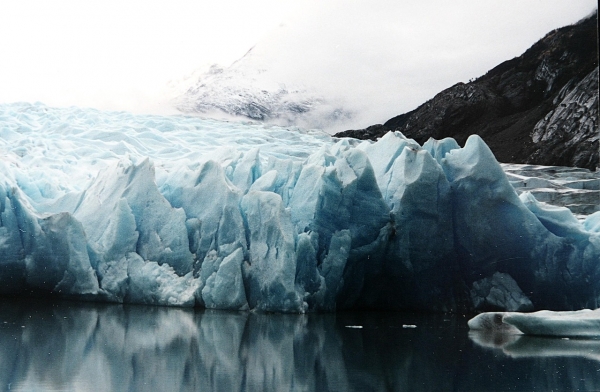
Last November, a study led by Adrien Wehrlé, a researcher in the department of geography at the University of Zürich, Switzerland, looked at the massive calving response of one of West Greenland’s active glaciers, Sermeq Kujalleq in the Kangia icefjord (SKK), to the drainage of two surface lakes.
Last November, a study led by Adrien Wehrlé, a researcher in the department of geography at the University of Zürich, Switzerland, looked at the massive calving response of one of West Greenland’s active glaciers, Sermeq Kujalleq in the Kangia icefjord (SKK), to the drainage of two surface lakes. Called supraglacial lakes, these are temporary meltwater ponds that form and accumulate in the depressions or holes on the surface of glaciers and ice sheets. Using satellite and terrestrial radar observations, the researchers studied the response of SKK to the drainage of two supraglacial lakes in July 2022.
SKK, also known as the Jakobshavn glacier, is a large and rapidly retreating outlet glacier on the Greenland ice sheet. As one of the world’s fastest moving and most active ice streams located in West Greenland, it discharges more than 50 gigatons of ice into the ocean each year. Rising temperatures and increased melting will cause larger lakes that may increase the frequency and magnitude of drainage events, further degrading glaciers and contributing to sea level rise.
Between July 21 and 24, two supraglacial lakes located 13 km south of SKK and 25 km from the glacier’s edge released a catastrophic surge of fast-flowing meltwater that propagated all the way to the glacier’s lowest depths.
Read More: Columbia Climate School
Photo Credit: Life-Of-Pix via Pixabay