Arctic terrestrial permafrost ecosystems store around 1,300 gigatonnes of carbon from organic sources, such as from the remains of plants. Sediments in oceans and river deltas contain a further 400 gigatonnes.
Arctic terrestrial permafrost ecosystems store around 1,300 gigatonnes of carbon from organic sources, such as from the remains of plants. Sediments in oceans and river deltas contain a further 400 gigatonnes. Global warming, however, is taking its toll on this natural freezer: temperatures in the Arctic are rising faster than anywhere else on our planet, with the result that permafrost in the region is thawing rapidly. The carbon stored here can then enter the Arctic Ocean via rivers and eroding coastlines. “Consequently, up to 0.02 gigatonnes are entering the sea each year, and according to forecasts, this outflow could rise by 70 to 150 per cent by the year 2100,” says Dr Manuel Ruben, lead author of the study from the Alfred Wegener Institute, Helmholtz Centre for Polar and Marine Research (AWI). “However, how much of this is released back into the atmosphere as a greenhouse gas and how much is stored in the seabed has, until now, been largely unknown.” Yet, this knowledge is essential for assessing the climate impact of thawing permafrost.
To get to the bottom of this unknown, the researchers retrieved and analysed sediment cores taken at various intervals off the coast of the Canadian island of Herschel Island. The cores contain deposits spanning around 50 years. Analysis of the sediments revealed something surprising: “Although the sea here carries away huge quantities of organic carbon from the coast, surprisingly little of it ends up in the ocean’s active carbon cycle,” says Manuel Ruben. “Microorganisms convert around ten per cent of the organic carbon from the sediments into gases, which rise into the water and can then enter our atmosphere.” The major share, however, is stored in the seabed.
Read more at: Alfred Wegener Institute
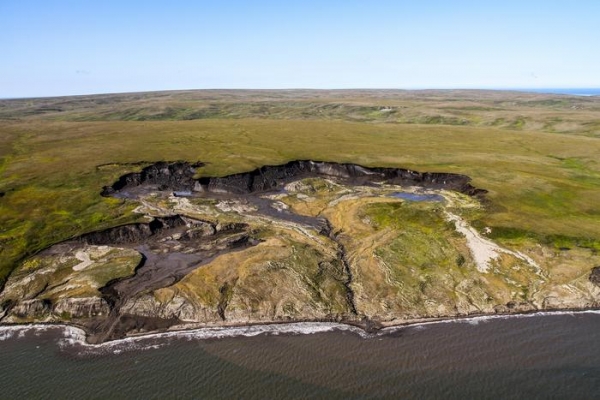
Permafrost in the Arctic stores large quantities of organic carbon. When the frozen ground thaws or coastal sections erode, this carbon can enter the sea, where microorganisms can break it down and convert it into climate-damaging greenhouse gases. (Photo Credit: die9ov via Alfred-Wegener-Institut / Jaroslav Obu)