Harmful algal blooms (HABs) have become an increasingly common threat to lakes, rivers and coastal waters across the United States, endangering drinking water supplies, aquatic ecosystems, public health and local economies.
Harmful algal blooms (HABs) have become an increasingly common threat to lakes, rivers and coastal waters across the United States, endangering drinking water supplies, aquatic ecosystems, public health and local economies. Now, researchers at Florida Atlantic University are developing an innovative technology that could help stop these blooms before they spread.
FAU’s College of Engineering and Computer Science has received an $800,475 grant from the Gulf of America Division of the U.S. Environmental Protection Agency to develop an artificial intelligence-guided system that removes excess phosphorus – one of the primary drivers of HABs – from freshwater systems. The three-year project began July 1.
The project, titled “AI-Guided Use of 3D-Printed Adsorbents for Phosphate Removal,” is led by principal investigator Masoud Jahandar Lashaki, Ph.D., an associate professor in FAU’s Department of Civil, Environmental and Geomatics Engineering. Co-principal investigators are Yalan Liu, Ph.D., an assistant professor, and Mohammed Abdellatef, Ph.D., an assistant professor both from FAU’s Department of Civil, Environmental and Geomatics Engineering. Huichun (Judy) Zhang, Ph.D., of Case Western Reserve University, will serve as the project’s sub-awardee.
Read more at: Florida Atlantic University
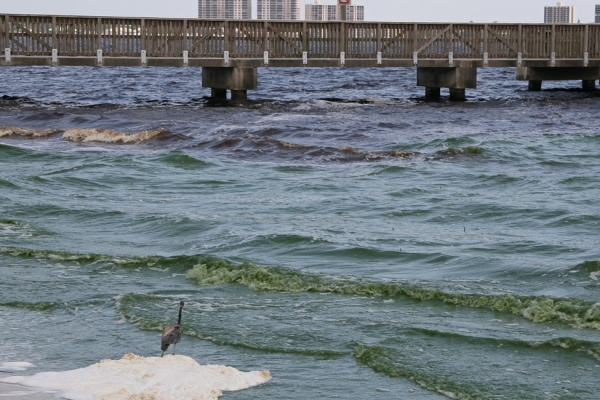
Harmful algal blooms in Florida’s Lake Okeechobee in 2018. (Photo Credit: Brian Lapointe, Ph.D.)