A partnership between the University of Rhode Island and Rhode Island Department of Health will study manganese levels in Rhode Island’s drinking water.
A partnership between the University of Rhode Island and Rhode Island Department of Health will study manganese levels in Rhode Island’s drinking water. The project, “Statewide Support for Manganese Management in Rhode Island,” will be funded by a grant from the Emerging Contaminants in Small and Disadvantaged Communities through the health department’s Center for Drinking Water Quality and Rhode Island Infrastructure Bank. It runs through Sept. 30, 2030.
Manganese is naturally occurring and comprises an appreciable portion of the earth’s crust. New England has higher concentrations of manganese than other parts of the U.S., due to glacial drifts that make up the region’s geology. Rhode Island depends on groundwater sources that have contact with the subsurface. Groundwater supplies roughly 26 percent of the state’s population with drinking water with an estimated two-thirds of that from public water supply and another third from private wells.
“Manganese in drinking water is a pervasive health issue and treatment challenge across Rhode Island,” said Zach Shepard, principal environmental health risk assessment toxicologist on the project for RIDOH and a URI alumnus. “Public water systems, especially small systems and private well owners, are impacted by manganese in their water. In this project, RIDOH has partnered with URI to provide technical assistance to people who are impacted by manganese.”
Read more at: University of Rhode Island
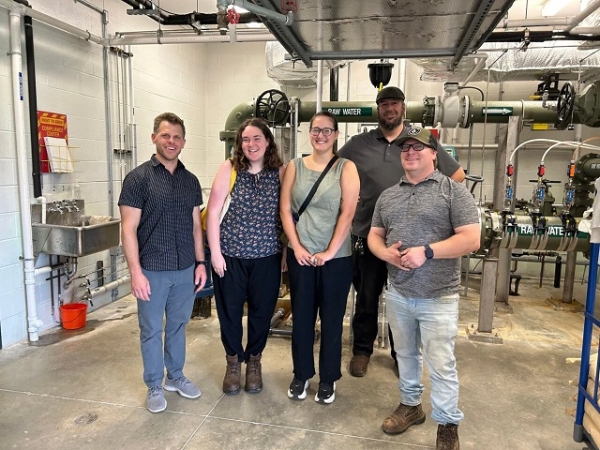
Principal investigator Associate Professor Joseph Goodwill, from left, poses with URI graduate student Liz Bunker, Emma Crisfield of RIDOH, Alex Paille and Bobby Ray from Town of Cumberland. (Photo Credit: Joseph Goodwill)