Engineers have developed a strain of a common bacterial species that can feed exclusively on the three major sugars present in corn stalks.
Engineers have developed a strain of a common bacterial species that can feed exclusively on the three major sugars present in corn stalks. While the new multiple-sugar-consuming strain of the bacteria Pseudomonas putida is interesting in its own right, a new paper published in Nature Communications on July 29, 2026 outlines the broader implications of this project for the future of biomanufacturing.
The research team led by bioengineers at the University of California San Diego uncovered new insights for leveraging the process of evolution to create novel strains of microbes that are highly adept at feeding off of low-cost feedstocks like agricultural waste or even mixed plastics.
“Given the likelihood that some of the most economically viable biomanufacturing feedstocks of the future will be complex mixtures of different components, this work has far reaching implications. With our automated culturing platform, we engineered a bacterial strain using evolution capable of taking up all three sugars found in corn stalks quickly and simultaneously,” said Adam Feist, a bioengineering professor at UC San Diego and the senior author on the paper. “We found that the key was evolving strains under a specific mixture of sugars that required complete consumption of all three of the sugars in order for the strain to outcompete other variants. This produced versatile generalist strains, rather than narrow specialists.”
Read More: University of California – San Diego
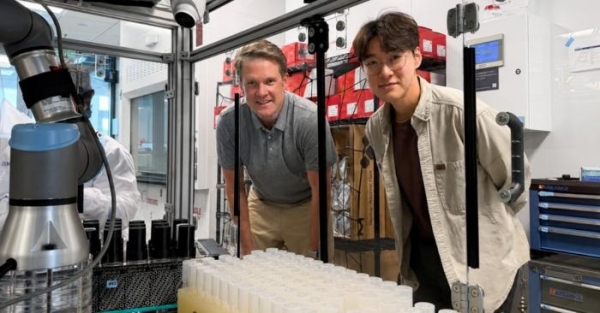
Image: UC San Diego bioengineering professor Adam Feist (L) and Sunghwa Woo, a postdoctoral researcher in the Feist lab at the UC San Diego Jacobs School of Engineering. (Credit: University of California San Diego)