Scientists have uncovered a previously unknown natural process that dramatically increases the number of cloud-forming particles in the Arctic atmosphere - potentially altering cloud cover, sunlight reflection, and future climate change.
Scientists have uncovered a previously unknown natural process that dramatically increases the number of cloud-forming particles in the Arctic atmosphere - potentially altering cloud cover, sunlight reflection, and future climate change.
Publishing their findings in Nature Geoscience, an international research team led by the University of Birmingham - including partners from China and Spain - reveals the first real-world evidence that, where Arctic sea ice meets open ocean, marine life and sunlight combine to release a chemical mixture that seeds the sky with cloud-forming particles.
The team found that a combination of naturally occurring iodine, sulphur and organic compounds are emitted to create new atmospheric particles. Near the ice edge, the researchers watched the number of particles capable of forming cloud droplets rising fifty-fold in a day.
Read more at: University of Birmingham
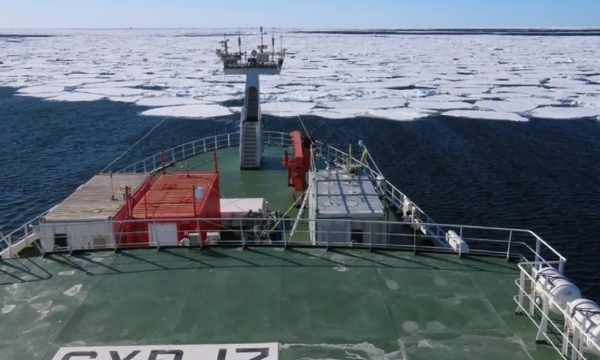
View from a ship's bridge over ice floes (Photo Credit: University of Birmingham)