As part of The Conversations’ “Curious Kids” series, an astronomer explains how a runaway greenhouse effect has made the surface temperature of Venus hot enough to melt lead.
As part of The Conversations’ “Curious Kids” series, an astronomer explains how a runaway greenhouse effect has made the surface temperature of Venus hot enough to melt lead.
When the solar system had just formed, 4.5 billion years ago, Venus was probably a tropical paradise. Oceans of water likely covered its surface, and puffy clouds dotted its skies. At that time, Mercury, the planet closest to the Sun, was undoubtedly the hottest planet in the solar system.
But then the Sun grew brighter, and a series of events known as a runaway greenhouse effect caused Venus’s surface temperature to soar well past Mercury’s. To be sure, as the closest planet to the Sun, parts of Mercury are still extremely hot. Its surface temperature on its sunlit side is around 800 degrees Fahrenheit (430 degrees Celsius), hot enough to melt lead.
I’m a space scientist with a passion for teaching physics and astronomy. I’ve seen Venus shine brightly in the western sky just after sunset, and, on rare occasions, seen Mercury briefly appear as an “evening star.”
Read More: University of Southern California
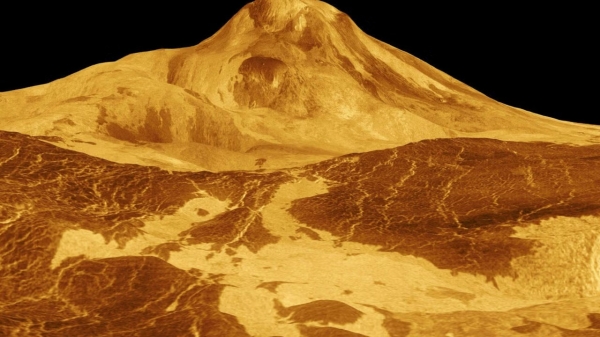
Image: The surface of Venus, as reconstructed from radar data collected by NASA’s Magellan mission. (Credit: NASA/JPL, CC BY-NC-SA)