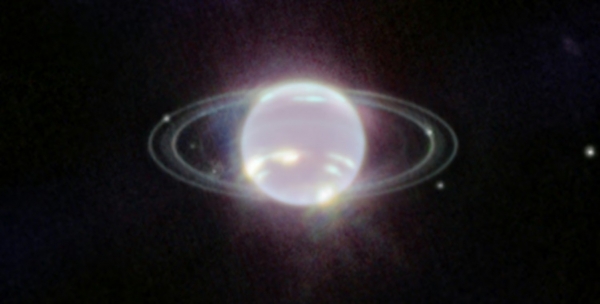
In 1989, the Voyager 2 mission discovered six new moons orbiting Neptune, including five tiny ones that orbit just outside the planet's main rings.
In 1989, the Voyager 2 mission discovered six new moons orbiting Neptune, including five tiny ones that orbit just outside the planet's main rings. Because of their small sizes and locations, these satellites have been difficult to study from Earth. Now, using NASA's James Webb Space Telescope (JWST), a team of Caltech researchers has observed Neptune's rings and three of those moons—Larissa, Galatea, and Proteus—and found that their composition is unique among outer solar system bodies.
These findings point to the existence of an original moon system that was demolished when Triton, Neptune's biggest moon, was likely captured by the planet's gravity after it formed elsewhere in the solar system. The researchers believe remnants left behind from this smashup then came together to form the inner moons seen today.
"If Neptune once had a system of moons that looked something like what we see at Uranus today, we expect it would've been completely destroyed by the process of Triton getting captured," says former Caltech graduate student Ryleigh Davis (PhD '26), lead author of a paper about the team's findings publishing July 29 in Science Advances. "This is exciting new evidence that something catastrophic happened at Neptune that completely destroyed its original satellites, and we're getting to see the fingerprints left behind by that process."
Read More: Caltech
Credit: Image: NASA, ESA, CSA, STScI; Image Processing: Joseph DePasquale (STScI), Naomi Rowe-Gurney (NASA-GSFC)