

Microplastics are turning up almost everywhere – from oceans and rivers to soils and sediments – yet far less is known about what happens when they enter freshwater wetlands.
Microplastics are turning up almost everywhere – from oceans and rivers to soils and sediments – yet far less is known about what happens when they enter freshwater wetlands. Often overlooked in favor of marine and coastal environments, wetlands can act as both pathways and traps for microplastics, potentially capturing and retaining pollution.
That knowledge gap is particularly important in small, urban-adjacent wetlands throughout Florida, where stormwater runoff, recreational activity and connections to rivers and other waterways can introduce microplastics. Yet little is known about how these particles move and accumulate within these ecosystems.
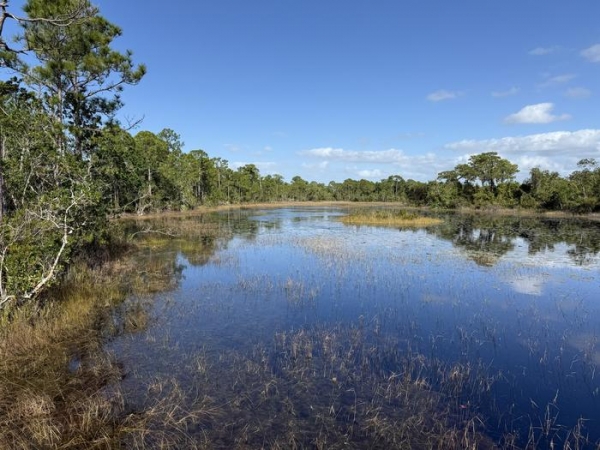
To help fill these gaps, Florida Atlantic University researchers examined microplastics at Spruce Bluff Preserve, a 97-acre freshwater wetland along the St. Lucie River in Port St. Lucie. The study provides the first detailed look at how microplastics are distributed across the preserve and how vegetation, sediment composition and proximity to water influence where particles accumulate.
Researchers collected 40 surface sediment samples from eight transects spanning different ecological zones. Samples were collected every 5 meters in December 2024 during the dry season, and researchers recorded each site’s distance from water. They also used infrared spectroscopy to confirm a subset of particles, providing a more accurate estimate of microplastic abundance.
Read More: Florida Atlantic University
Image: The main open-water area of Spruce Bluff Preserve, a 97-acre freshwater wetland along the St. Lucie River in Port St. Lucie in Florida. (Credit: Erik Johanson, Florida Atlantic University)


