Synthetically engineered marine bacteria accelerate natural bioweathering with potential for decarbonizing the atmosphere at industrial scales.
Synthetically engineered marine bacteria accelerate natural bioweathering with potential for decarbonizing the atmosphere at industrial scales.
Rock weathering, the breakdown and dissolving of rocks and minerals caused by their exposure to water, air, and biological life, is a major regulator of Earth’s atmospheric CO2 levels and climate. Throughout Earth’s history, rock weathering has been faster during warm periods with increased atmospheric CO2 levels. Dissolved minerals ultimately wash into the ocean, where they draw CO2 from the atmosphere and cool the planet again. While this thermostat is responsible for the temperate climate we enjoy on Earth, the weathering cycle occurs over hundreds of thousands of years.
In search of climate solutions, scientists have asked if the rock weathering cycle could be sped up, resulting in a number of new companies pursuing Enhanced Rock Weathering (ERW). By scattering crushed silicate rocks on agricultural surfaces or into water, they aim to pull excess CO2 out of the atmosphere. Although this strategy is generally safe and environmentally friendly, it is still too slow to affect the global carbon balance or to be economically viable at industrial scale.
Read More: Wyss Institute for Biologically Inspired Engineering at Harvard
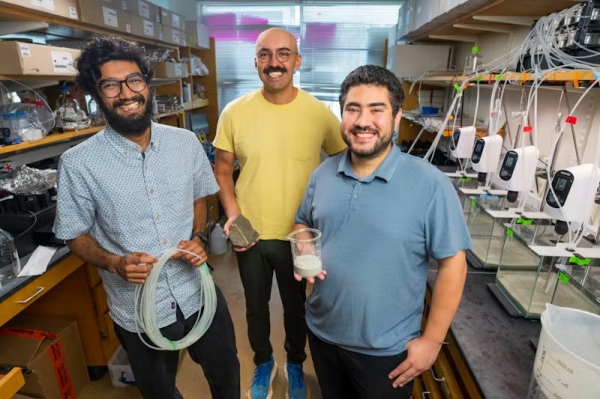
Image: This photo shows Amogh Jalihal, Neil Dalvie, and team member Mohammed Hijaz in the rockweathering lab that they equipped with multiple rock-seawater bioreactors to pursue their rockweathering study. (Credit: Wyss Institute at Harvard University)