After orbiting Earth in 1962, John Glenn remarked on an irrigated valley northwest of El Paso, Texas, that stood out against the surrounding desert.
After orbiting Earth in 1962, John Glenn remarked on an irrigated valley northwest of El Paso, Texas, that stood out against the surrounding desert. Human-made lakes along the Rio Grande have made agriculture possible and turned an otherwise dry area green, as Glenn observed. With water for irrigation, farmers there produce crops such as alfalfa, cotton, onions, pecans, and the regional specialty: Hatch green chiles.
Abnormally dry conditions in the Rio Grande basin, however, have stressed these water resources. Extreme drought has plagued the region for the past several years. The earliest snowmelt on record at the river’s headwaters in the southern Rockies exacerbated the situation in 2026.
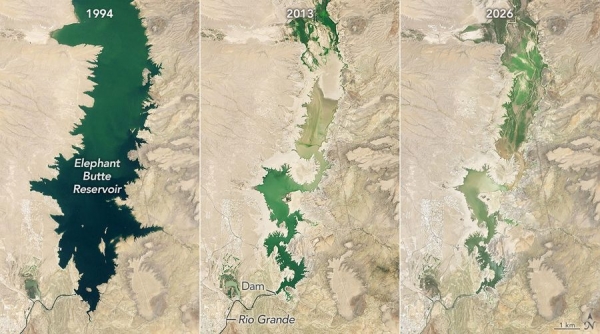
These factors have contributed to driving Elephant Butte Reservoir, the largest reservoir in New Mexico, to its lowest level since 1971. When the image above was acquired on July 27, 2026 (right), it stood at 1.4 percent capacity. For comparison, the reservoir was nearly full on June 2, 1994 (left); levels were high for much of the period between 1985 and 2000. On July 8, 2013 (center), amid another drought, the lake hit its annual low of 2.9 percent capacity.
The low water levels in 2026 exposed debris along the shoreline and left boat ramps in Elephant Butte Lake State Park covered in sediment. But the lake likely bottomed out for the year in late July. Water releases for agriculture stopped after July 28, state officials said, allowing it to slowly begin to refill.
Read More: NASA Earth Observatory
Image: New Mexico’s Elephant Butte Reservoir was nearly full on June 2, 1994 (left), in contrast with very low levels during periods of drought on July 8, 2013 (center), and July 27, 2026 (right). The images were acquired with the TM (Thematic Mapper) on Landsat 5 and the OLI (Operational Land Imager) on Landsat 8 and Landsat 9. (NASA Earth Observatory/Michala Garrison)