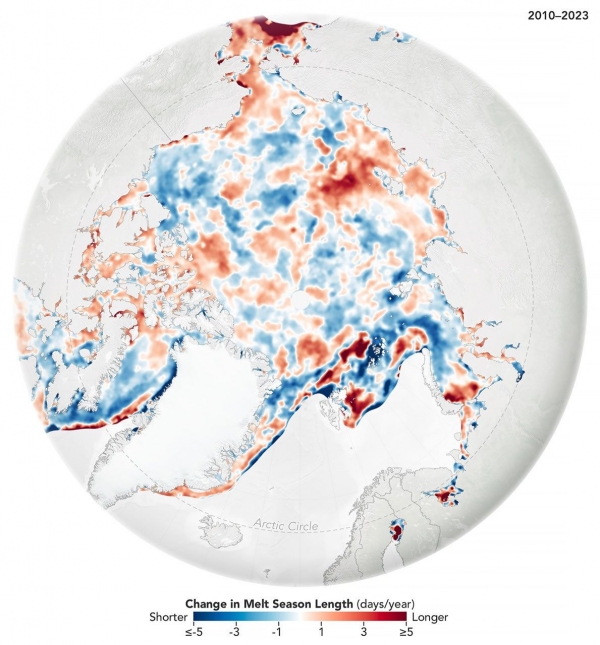
For decades, Arctic sea ice has been melting earlier in spring and freezing later in fall, extending the melt season and contributing to widespread ice loss.
For decades, Arctic sea ice has been melting earlier in spring and freezing later in fall, extending the melt season and contributing to widespread ice loss. A new NASA-led study has found that while the Arctic melt season has lengthened dramatically since satellite records began, that trend unexpectedly stabilized around 2010.
The Arctic sea ice melt season is now about 40 days longer than it was in 1979, according to the study. Most of the increase occurred before 2010. Since then, the average melt season length has remained relatively unchanged, despite large year-to-year fluctuations.
Researchers analyzed satellite observations between 1979 and 2023 to track when sea ice begins to melt each spring and refreezes each autumn. They found that the change was driven primarily by sea ice freezing later in the year rather than melting earlier in the spring.
Read more at: NASA
Since the start of the satellite record, the Arctic sea ice melt season has lengthened in most decades, particularly in the 2000s (left). Since 2010 (right), the melt season appears to have stabilized. (Photo Credit: NASA Earth Observatory images by Michala Garrison based on data from Boisvert, L., et al.)