Documenting the seasonal fate of these tiny marine organisms is a step toward understanding how ecosystems in the world's fastest-warming region may change as ice recedes.
Documenting the seasonal fate of these tiny marine organisms is a step toward understanding how ecosystems in the world's fastest-warming region may change as ice recedes.
Tiny plantlike organisms called phytoplankton that form the base of marine food webs topped by orcas, whales, and sharks usually get eaten or slowly sink to the seafloor, carrying carbon as they go.
Across most of the ocean, the descent from sunlit surface layers takes weeks. But in the Arctic’s Chukchi Sea, scientists have found that a convergence of currents pushes phytoplankton from under the ice to the seafloor at four times the usual speed.
Read More: Stanford Doerr School of Sustainability
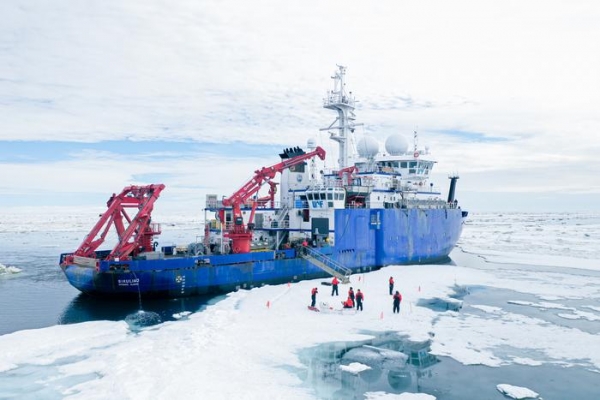
Image: In 2023, researchers visited the Arctic’s Chukchi Sea aboard the R/V Sikuliaq to study how local currents and sea ice affect the seasonal growth of plant-like organisms essential to ocean carbon storage and food webs. (Image credit: Lexi Arlen, Xavier Proctor) (Credit: Lexi Arlen, Xavier Proctor)