The Southern Ocean covers almost a third of the world’s ocean surface and connects the basins of every other major ocean, with unforgiving conditions that make research difficult.
The Southern Ocean covers almost a third of the world’s ocean surface and connects the basins of every other major ocean, with unforgiving conditions that make research difficult. Its extremely cold waters play a major role in the global carbon sink—the roughly 30% of anthropogenic carbon emissions absorbed each year—by the world’s oceans as a whole.
That combination of climate significance and physical inaccessibility makes monitoring and understanding how the Southern Ocean regulates the global atmosphere both critically important and exceedingly challenging. Closing that knowledge gap is a priority for researchers and governments around the world.
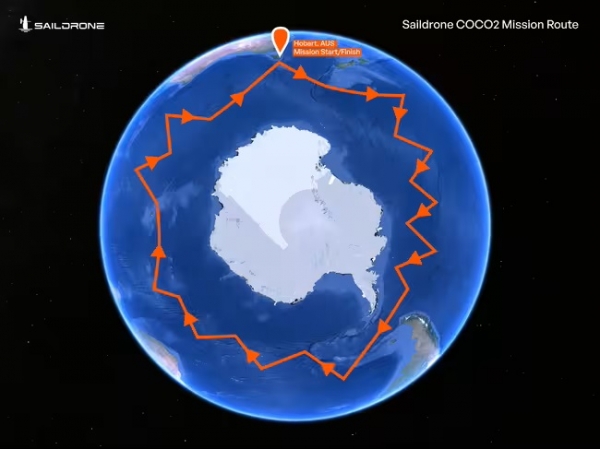
Led by researchers at the National Oceanic and Atmospheric Administration’s (NOAA) Pacific Marine Environmental Laboratory (PMEL) and Columbia University, the Constraining Ocean Carbon with Optimized Observing (COCO2) project is a five-year initiative that will deploy Saildrone uncrewed surface vehicles (USVs) to implement a novel and scalable approach to observing air-sea carbon exchange and reducing uncertainty in estimates of the global carbon sink. The USVs are small robotic sailing vessels equipped with onboard solar-powered sensors. They will spend many months at sea, sending real-time data to scientists from the remote and rough waters of the Southern Ocean that are often too difficult and expensive for research ships to reach.
Read More at: Columbia Climate School
Approximate track the uncrewed surface vehicles will take on their Southern Ocean circumnavigation of Antarctica. (Photo Credit: Saildrone)