

New research from the University of Copenhagen suggests that previously overlooked property of ghost particles may be a key part of the explanation for why some stars explode, while others collapse into black holes.
New research from the University of Copenhagen suggests that previously overlooked property of ghost particles may be a key part of the explanation for why some stars explode, while others collapse into black holes.
As a star nears the end of its life, it faces two very different fates: it can either explode as a supernova, leaving behind a neutron star, or it can collapse and become a black hole. But which of these two outcomes occurs remains one of astrophysics’ great unanswered questions.
Now, a new study from the University of Copenhagen shows that neutrinos – also known as ‘ghost particles’ – and their ability to change “flavor” may play a far greater role in determining the fate of the dying massive star.
This ‘flavor change’ – or neutrino flavor conversion – essentially means that the neutrino particles switch from one type to another. And their type or flavor is significant in terms of how they interact with the matter in the cores of dying stars.
Read More: University of Copenhagen
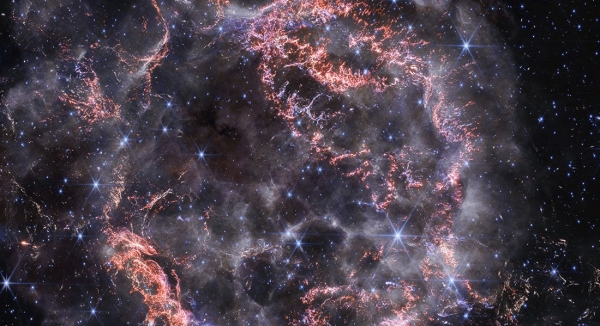
Image: A new high-definition image from NASA’s James Webb Space Telescope’s NIRCam (Near-Infrared Camera) unveils intricate details of supernova remnant Cassiopeia A (Cas A), and shows the expanding shell of material slamming into the gas shed by the star before it exploded. Credit: NASA, ESA, CSA, STScI, Danny Milisavljevic (Purdue University), Ilse De Looze (UGhent), Tea Temim (Princeton University)


