The Amazon rainforest in South America is so critical to the health of Earth’s atmosphere that it’s known as the “lungs of the planet.”
The Amazon rainforest in South America is so critical to the health of Earth’s atmosphere that it’s known as the “lungs of the planet.” In part, that’s because the forest’s dense vegetation absorbs vast amounts of carbon dioxide from Earth’s atmosphere, helping to counteract global human carbon emissions.
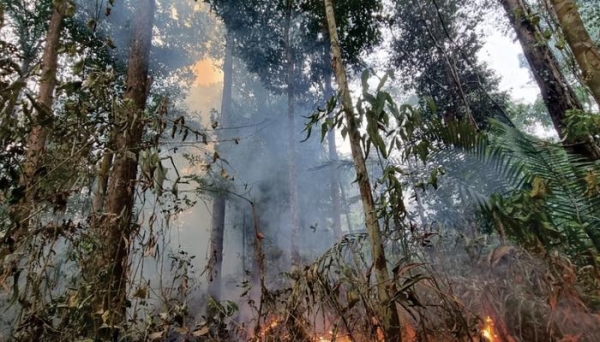
But in recent decades, the Amazon rainforest has been degraded by deforestation, drought and fires. Now, a new study in Nature by an international team of researchers, including from the University of Kansas, shows the hotter, drier Amazon is a net source of global carbon emissions. Only in the wettest years does the rainforest remain closer to carbon neutral.
The paper, led by Brazil’s National Institute for Space Research, is based on a unique dataset: 15 years of airborne measurements of atmospheric carbon, collected by research planes sampling the air at different elevations above the rainforest.
Read more at: University of Kansas
Fires burning in the Amazon rainforest. A study in Nature by an international team of researchers, including from the University of Kansas, shows the hotter, drier Amazon is a net source of global carbon emissions. (Photo Credit: Gatti et al.)