Cornell researchers, working with upstate New York battery company Charge CCCV, also known as C4V, have developed a real-time diagnostic approach to drastically improve one of the most expensive and time-consuming stages of lithium-ion battery manufacturing: forming the battery.
Cornell researchers, working with upstate New York battery company Charge CCCV, also known as C4V, have developed a real-time diagnostic approach to drastically improve one of the most expensive and time-consuming stages of lithium-ion battery manufacturing: forming the battery.
The approach can reduce formation time by more than half, free up factory floor space and reduce a manufacturer’s overall power use by 10% to 15%, saving up to $100 million annually in large operations, the research team said.
The battery formation process involves a series of initial charge and discharge cycles that create protective layers and help determine how well a battery will perform over its lifetime. The process accounts for roughly one-third of production costs and a quarter of factory floor space.
Read more at: Cornell University
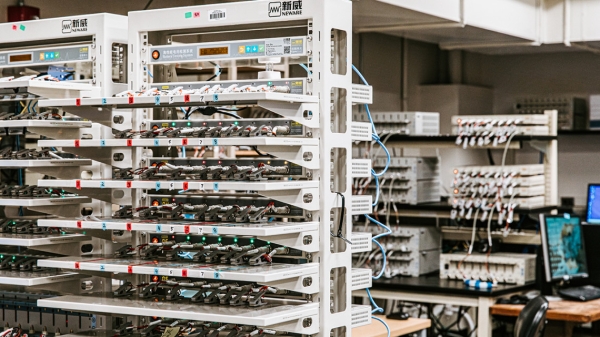
Battery cycler system in Olin Hall used by the Kalra research group to charge and discharge batteries to evaluate their performance in collaboration with Binghamton-based battery company Charge CCCV. (Photo Credit: Allison Usavage/Duffield Engineering)