About 20,000 years ago, an enormous, floating ice shelf more than a mile thick helped lock in three of the largest ice sheets in northern Canada and Greenland.
About 20,000 years ago, an enormous, floating ice shelf more than a mile thick helped lock in three of the largest ice sheets in northern Canada and Greenland. When that ice shelf disappeared, it helped destabilize the surrounding ice sheets, allowing more land-based ice to flow into the ocean and contribute to hundreds of feet of sea level rise, establishing modern coastlines as we know them.
Those are the findings of a new study by an international team of researchers, including scientists at the Lamont-Doherty Earth Observatory, part of the Columbia Climate School, that uncovered evidence of an ancient ice shelf in Baffin Bay, west of Greenland. The size and scale of such a floating fortress of ice was not previously known, and it provides clues to the future of today’s massive ice sheets in Antarctica and the sea-level rise that could follow if they melt.
“These ice sheets are like a Gothic cathedral. You have this big, tall cathedral of ice and these flying buttresses of floating ice shelves that support them. They help stop the ice on land from flowing into the ocean and contributing to sea level rise,” said Robert Hatfield, an associate professor of geology at the University of Florida and co-author of the new study. “One of the biggest concerns in Antarctica right now is how fast that ice that’s on land flows into the ocean when we lose that buttressing effect.”
Read More: Columbia Climate School
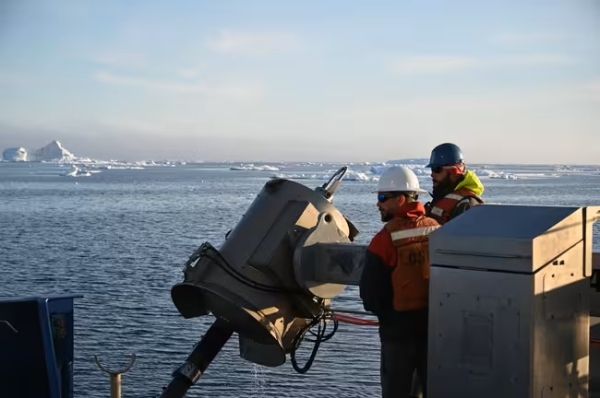
Technicians preparing to deploy the jumbo piston corer from the starboard side of R/V Armstrong. (Photo Credit: Brendan Reilly)