An international study involving TU Graz shows that lake-terminating glaciers lose a particularly large amount of ice.
An international study involving TU Graz shows that lake-terminating glaciers lose a particularly large amount of ice. Glacial lakes amplify the effects of climate and topography.
Glacial lakes can accelerate the retreat of glaciers. If glaciers border a lake, the water can melt the ice from underneath; furthermore, chunks of ice can break off and fall into the lake. The extent to which these processes influence the situation, compared with other factors, had not been sufficiently clarified at a global level until now. An international research team, including Tobias Bolch from the Institute of Geodesy at Graz University of Technology (TU Graz), has now investigated this question by mapping and analysing all glacial lakes worldwide. The researchers have published their findings in the journal Nature Climate Change.
Climate and Topography Determine Ice Loss; Lakes Exacerbate It
The researchers found that lake-terminating glaciers lost an average of 66 centimetres of water equivalent per year between 2000 and 2020. This means that the annual loss of ice is equivalent to a layer of water with a thickness of 66 centimetres. For glaciers that end on dry land, the average was 40 centimetres per year; for glaciers with a tongue ending in the sea, it was 36 centimetres.
Read More: Graz University of Technology
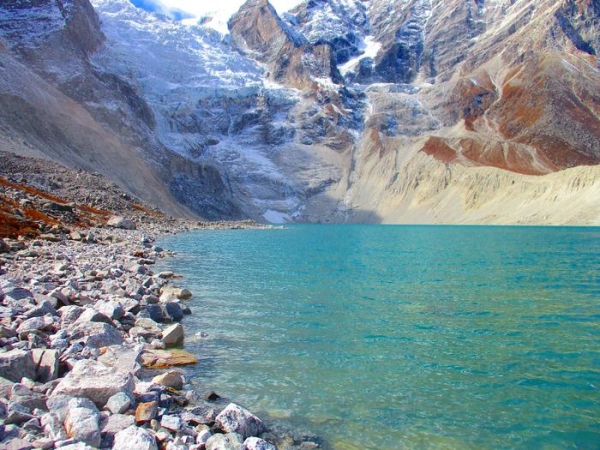
Image: The Jialong Co glacial lake in the central Himalayas has grown considerably in recent decades. (Credit: Tobias Bolch)