Many oceanic islands far from active plate tectonic boundaries contain materials that clearly originate from continents, even though they are located in the middle of an oceanic plate.
Many oceanic islands far from active plate tectonic boundaries contain materials that clearly originate from continents, even though they are located in the middle of an oceanic plate. Where do the continental remnants come from? Are they sediments that are recycled when oceanic plates subduct into the mantle? Or do they originate from the depths of the Earth's mantle and are carried upward by hot currents, known as mantle plumes? Both explanations are being discussed, but they fall short. This is because some volcanic regions show little evidence of crustal recycling, while others are too cool to be driven by mantle plumes.
Researchers at the University of Southampton and the GFZ Helmholtz Centre for Geosciences have now proposed a new explanation. Geochemical analyses and modelling have revealed the following picture: When continents break apart, a wave of instability is created at a depth of more than a hundred kilometres. This “mantle wave” scrapes material from the underside of the continents along the base, which is then transported sideways into the Earth's mantle beneath the oceans.
There, these remnants of continental roots feed volcanic eruptions in the ocean crust over millions of years. Sometimes the material travels more than a thousand kilometres from the continental interiors before it forms oceanic islands.
Read More: GFZ Helmholtz Centre for Geosciences
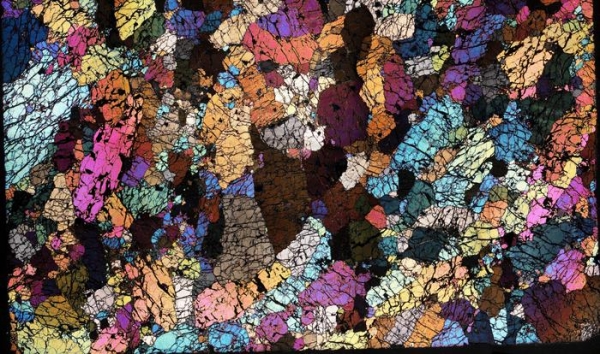
Image: A microscopic image of a fragment of the lowermost continental mantle — the crystalline roots of the continents. This is the type of material that the authors propose is stripped away and laterally transported into the oceanic mantle. (Photo Credit: Prof Tom Gernon - University of Southampton)