Norway is the world’s largest producer of farmed Atlantic salmon and a top exporter of seafood, while the United States remains the largest importer of these products, according to the Food and Agriculture Organization.
Norway is the world’s largest producer of farmed Atlantic salmon and a top exporter of seafood, while the United States remains the largest importer of these products, according to the Food and Agriculture Organization. Two MIT students recently traveled to Trondheim, Norway to explore the cutting-edge technologies being developed and deployed in offshore aquaculture.
Beckett Devoe, a senior in artificial intelligence and decision-making, and Tony Tang, a junior in mechanical engineering, first worked with MIT Sea Grant through the Undergraduate Research Opportunities Program (UROP). They contributed to projects focusing on wave generator design and machine learning applications for analyzing oyster larvae health in hatcheries. While near-shore aquaculture is a well-established industry across Massachusetts and the United States, open-ocean farming is still a nascent field here, facing unique and complex challenges.
To help better understand this emerging industry, MIT Sea Grant created a collaborative initiative, AquaCulture Shock, with funding from an Aquaculture Technologies and Education Travel Grant through the National Sea Grant College Program. Collaborating with the MIT-Scandinavia MISTI (MIT International Science and Technology Initiatives) program, MIT Sea Grant matched Devoe and Tang with aquaculture-related summer internships at SINTEF Ocean, one of the largest research institutes in Europe.
Read more at: Massachusetts Institute of Technology
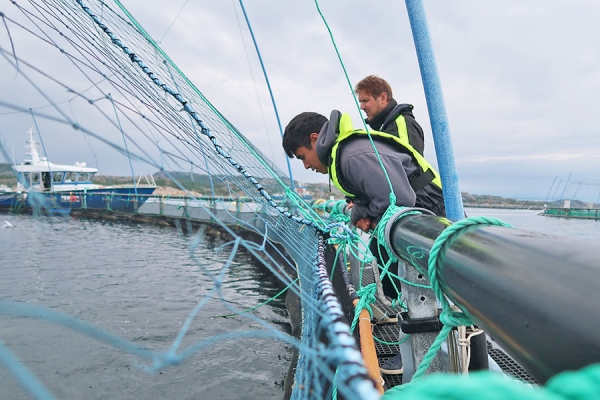
MIT Sea Grant student intern Beckett Devoe (foreground) looks into one of the net pens at the Singsholmen salmon farm off the island of Hitra in Norway. (Photo Credit: Lily Keyes/MIT Sea Grant)