

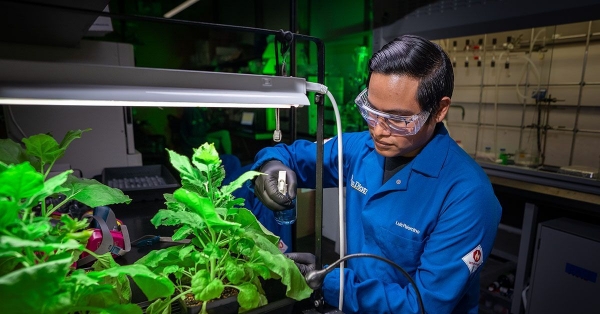
Engineers at the University of California San Diego have developed a spray-on polymer coating that could help plants resist harmful bacterial infections and survive drought.
Engineers at the University of California San Diego have developed a spray-on polymer coating that could help plants resist harmful bacterial infections and survive drought. The advance, published in ACS Materials Letters, could help strengthen global food security as increased environmental stresses continue to intensify plant disease pressures.
Bacterial infections are a growing threat to agriculture as they contribute to major crop losses worldwide. These infections, which are driven by both Gram-negative and Gram-positive bacteria, cause destructive plant diseases such as wilt, blight, speck and canker. Rising temperatures are also allowing pathogens to expand into new regions. As a result, crops are increasingly exposed to a variety of infections.
To tackle this challenge, researchers from the labs of Jon Pokorski and Nicole Steinmetz, both professors in the Aiiso Yufeng Li Family Department of Chemical and Nano Engineering at the UC San Diego Jacobs School of Engineering, and members of the UC San Diego Materials Research Science and Engineering Center (MRSEC), joined forces to develop an antibacterial coating that can be sprayed directly onto plant leaves.
Read More at: University of California San Diego
Luis Palomino, a chemical and nano engineering Ph.D. candidate at the UC San Diego Jacobs School of Engineering and co-first author of the study, sprays an antibacterial polymer coating onto the leaves of Nicotiana benthamiana. (Photo Credit:David Baillot/UC San Diego Jacobs School of Engineering)


