

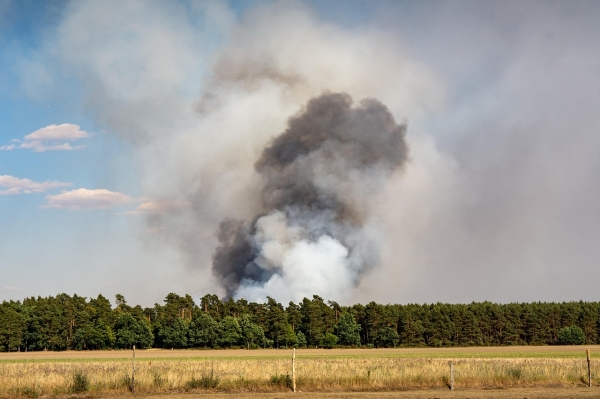
As fires burn the landscape, they spew airborne gases and particles, though their impact on air pollution might be underestimated.
As fires burn the landscape, they spew airborne gases and particles, though their impact on air pollution might be underestimated. A study in ACS’ Environmental Science & Technology reports that, around the world, wildfires and prescribed burns (i.e., wildland fires) could emit substantially more gases, including ones that contribute to air pollution, than previously thought. The researchers identified several regions with high wildland fire and human activity emissions, which may pose complex air-quality challenges.
“Our new estimates increase the organic compound emissions from wildland fires by about 21%,” says Lyuyin Huang, the first author of the study. “The inventory provides a foundation for more detailed air-quality modeling, health-risk assessment and climate-related policy analysis.”
Each year, large swaths of forests, grass and peat burn in wildfires, releasing a complex mix of water vapor, ash and carbon-based compounds into the air. Some of these carbon-based compounds are gases called volatile organic compounds (VOCs). Others that evaporate and turn into gases at warmer temperatures are known as intermediate- and semi-volatile organic compounds (IVOCs and SVOCs, respectively). And in the air, these partially-volatile compounds form fine particles — pollutants that can be harmful if breathed in — more easily than VOCs. However, most studies assessing wildland fire emissions overlook IVOCs and SVOCs because of their large number, which makes it hard to measure these compounds. Researchers led by Shuxiao Wang wanted to take IVOCs and SVOCs emissions along with VOCs into consideration to offer better insight into wildland fires’ impact on air quality, health and climate.
Read More: American Chemical Society
Photo Credit: Seaq68 via Pixabay


