

An international team of astronomers led by Canadian researchers has found something the universe wasn’t supposed to have: a galaxy cluster blazing with hot gas just 1.4 billion years after the Big Bang, far earlier and hotter than theory predicts.
An international team of astronomers led by Canadian researchers has found something the universe wasn’t supposed to have: a galaxy cluster blazing with hot gas just 1.4 billion years after the Big Bang, far earlier and hotter than theory predicts.
The result, published today in Nature, could upend current models of galaxy cluster formation, which predict such temperatures occur only in more mature, stable galaxy clusters later in the universe’s life.
“We didn’t expect to see such a hot cluster atmosphere so early in cosmic history,” said lead author Dazhi Zhou, a PhD candidate in the UBC department of physics and astronomy. “In fact, at first I was skeptical about the signal as it was too strong to be real. But after months of verification, we’ve confirmed this gas is at least five times hotter than predicted, and even hotter and more energetic than what we find in many present-day clusters.”
Read more at: University of British Columbia
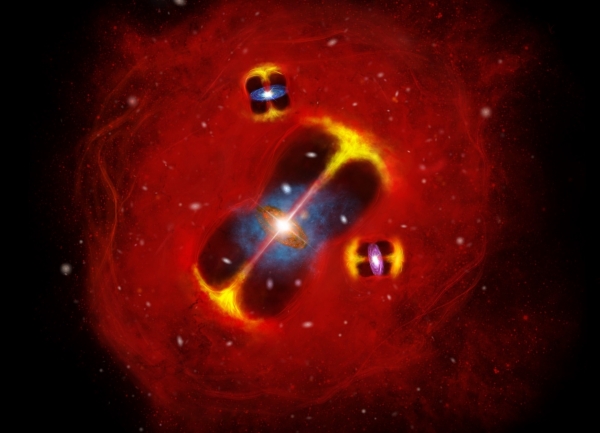
Artist’s impression of a forming galaxy cluster in the early universe: radio jets from active galaxies are embedded in a hot intracluster atmosphere (red), illustrating a large thermal reservoir of gas in the nascent cluster. (Photo Credit: Lingxiao Yuan)


