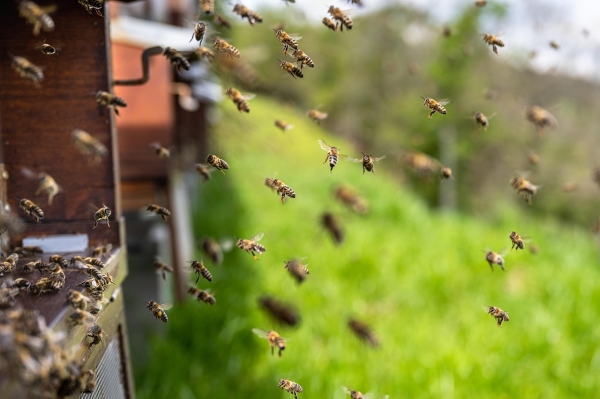
Although honey bees have the ability to regulate hive temperatures, new research published in Ecological and Evolutionary Physiology shows that extreme summer heat can overwhelm these critical pollinators' cooling systems, leading to significant colony population declines.
Although honey bees have the ability to regulate hive temperatures, new research published in Ecological and Evolutionary Physiology shows that extreme summer heat can overwhelm these critical pollinators' cooling systems, leading to significant colony population declines.
The research in “Negative Effects of Excessive Heat on Colony Thermoregulation and Population Dynamics in Honey Bees,” conducted during a hot Arizona summer, monitored nine honey bee colonies through three months of temperatures that frequently exceeded 40°C (104°F). The results indicate that intensifying heat waves worldwide represent a significant threat to honey bees and the pollination services they provide.
"Honey bee colonies have well-documented mechanisms to cope with heat exposure," write authors Jun Chen, Adrian Fisher II, Gloria DeGrandi-Hoffman, Cahit Ozturk, Brian H. Smith, Jennifer H. Fewell, Yun Kang, Kylie Maxwell, Kynadi Overcash, Keerut Chahal, and Jon F. Harrison. "However, there have been no studies to date that have assessed the limits of such thermoregulation or how natural heat waves affect the capacity of honey bees colonies to thermoregulate and grow."
Read More: University of Chicago Press Journals
Photo Credit: xiSerge via Pixabay