

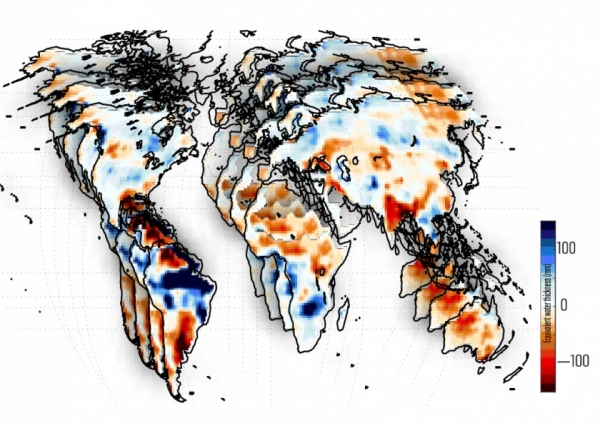
Water extremes such as droughts and floods have a huge impact on communities, ecosystems, and economies.
Water extremes such as droughts and floods have a huge impact on communities, ecosystems, and economies. Researchers with The University of Texas at Austin have turned their attention to tracking these extremes across Earth and have discovered what is driving them.
In a recent study published in AGU Advances, the researchers found that over the past two decades ENSO, a climate pattern in the equatorial Pacific Ocean that includes El Niño and La Niña, has been the dominant driver of total water storage extremes at the global level. What’s more, the researchers found that ENSO has a synchronizing effect on water storage extremes across continents.
Study co-author Bridget Scanlon, a research professor at the Bureau of Economic Geology at the UT Jackson School of Geosciences, said that understanding how extremes unfold across the world has humanitarian and policy impacts.
“Looking at the global scale, we can identify what areas are simultaneously wet or simultaneously dry,” Scanlon said. “And that of course affects water availability, food production, food trade — all of these global things.”
Read More: University of Texas at Austin
Image: A figure adapted from the paper showing extreme water storage anomalies across the world as detected by the GRACE and GRACE Follow-On satellites from 2002-2024. Credit: Ashraf Rateb.


