

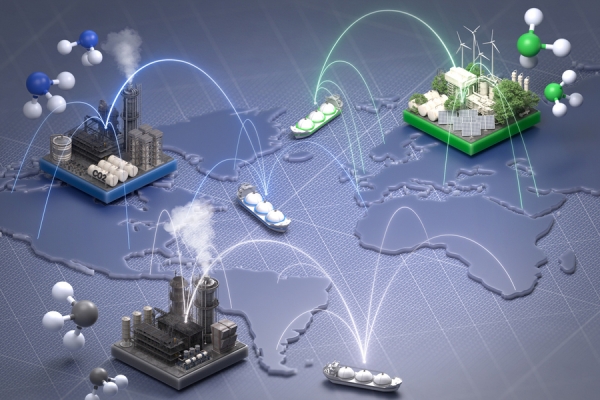
Many people are optimistic about ammonia’s potential as an energy source and carrier of hydrogen, and though large-scale adoption would require major changes to the way it is currently manufactured, ammonia does have a number of advantages.
Many people are optimistic about ammonia’s potential as an energy source and carrier of hydrogen, and though large-scale adoption would require major changes to the way it is currently manufactured, ammonia does have a number of advantages. For one thing, ammonia is energy-dense and carbon-free. It is also already produced at scale and shipped around the world, primarily for use in fertilizer.
Though current manufacturing processes give ammonia an enormous carbon footprint, cleaner ways to make ammonia do exist. A better understanding of how to guide the ammonia fuel industry’s continued development could improve carbon emissions, energy costs, and regional energy balances.
In a new paper, MIT Energy Initiative (MITEI) researchers created the largest combined dataset showing the economic and environmental impact of global ammonia supply chains under different scenarios. They examined potential ammonia flows across 63 countries and considered a variety of country-specific economic parameters as well as low- and no-carbon ammonia production technologies. The results should help researchers, policymakers, and industry stakeholders calculate the cost and lifecycle emissions of different ammonia production technologies and trade routes.
Read more at: Massachusetts Institute of Technology
Caption:“Before this, there was no harmonized datasets quantifying the impacts of this transition,” says lead author Woojae Shin. “It’s filling a major knowledge gap.” (Photo Credit: Woojae Shin and Guiyan Zang)


