

To reduce air pollution associated with ocean transport, the International Maritime Organization tightened restrictions on sulfur content in ship fuel, resulting in an 80% reduction in emissions by 2020.
To reduce air pollution associated with ocean transport, the International Maritime Organization tightened restrictions on sulfur content in ship fuel, resulting in an 80% reduction in emissions by 2020. That shift created an inadvertent real-world experiment in how man-made aerosols influence cloud formation over the ocean.
A team of atmospheric scientists led by University of Utah professor Gerald “Jay” Mace used this rare opportunity to explore the impact of reduced emissions on marine boundary layer clouds over the eastern North Atlantic. They discovered clouds’ internal structure changed, featuring fewer, but larger droplets of water. Yet the clouds’ reflectivity of sunlight surprisingly remained unchanged.
“You couldn’t plan this type of thing,” Mace said. “The shipping in the entire world went from one thing to another, almost like the flick of a switch, and it just so happened that that had a known effect on clouds globally. Doing a natural experiment like this, I don’t think it could ever happen again, unless we went back to sulfur fuels.”
Read More: University of Utah
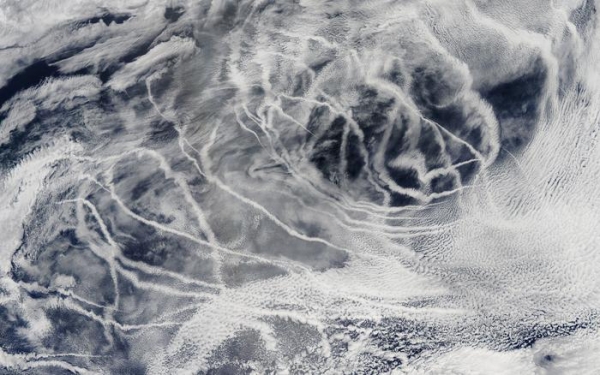
'Ship tracks' above the northern Pacific Ocean. These patterns are produced when fine particles from ship exhaust float into a moist layer of atmosphere. The particles seed new clouds or attract water from existing cloud particles. These tracks virtually disappeared after 2020 when shipping vessels switched to cleaner fuelds. Image taken by the Moderate Resolution Imaging Spectroradiometer (MODIS) onboard NASA’s Aqua satellite on July 3, 2010. (Photo Credit: NASA/GSFC/Jeff Schmaltz/MODIS Land Rapid Response Team.)


