For decades, scientists knew there was a huge swath of undetected and unaccounted for per- and polyfluoroalkyl substances (PFAS) in the atmosphere, often referred to as PFAS dark matter, but no one knew how much was missing or how to measure them.
For decades, scientists knew there was a huge swath of undetected and unaccounted for per- and polyfluoroalkyl substances (PFAS) in the atmosphere, often referred to as PFAS dark matter, but no one knew how much was missing or how to measure them. Now, a York University atmospheric chemistry research team has devised a way to test for one of the most ubiquitous elements of these potent greenhouse gases.
By measuring for gaseous fluorine, one of the most prevalent and overlooked contaminants, scientists can better understand the extent of previously unaccounted for PFAS, comprised of thousands of organofluorine compounds. These compounds, used in a wide range of products from food, paint, paper packaging and dental floss to cosmetics and agrochemicals, can off gas fluorine.
The researchers measured how much fluorine was released into the air both in the lab and outside using chemicals, such as fluorosurfactant liquids, and found 65 to 99 per cent of the fluorine in the air inside the lab was not normally unaccounted for, while outside that number was about 50 per cent.
Read more at: York University
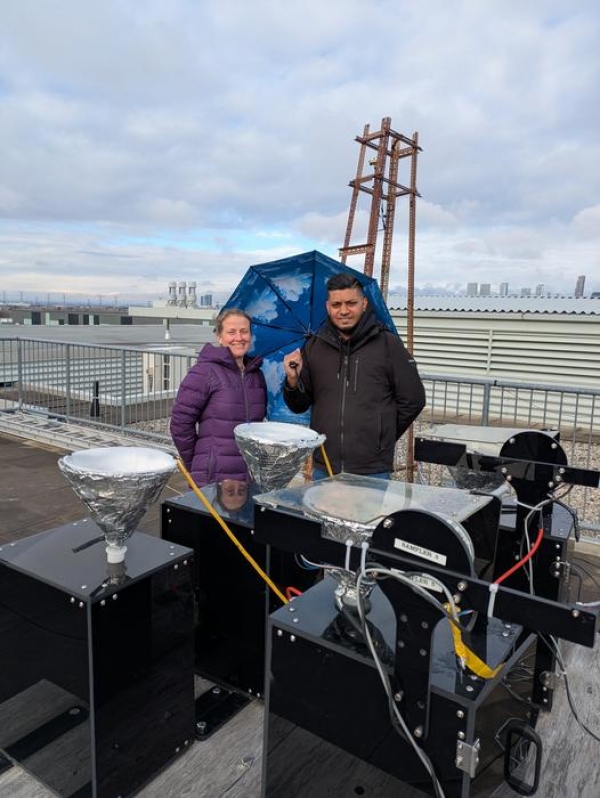
York University Atmospheric Professor Cora Young and PhD Candidate Daniel Persaud on the rooftop lab of the Air Quality Research Station. (Photo Credit: York University)