Solar panels and wind turbines increasingly dot the landscape, but the future of clean energy may well depend on how smoothly we burn hydrogen.
Solar panels and wind turbines increasingly dot the landscape, but the future of clean energy may well depend on how smoothly we burn hydrogen. Yet as anyone who’s lit a gas grill or fireplace knows, igniting a flame can be a bit tricky. Imagine how complex that process can be in commercial and industrial applications. Thanks to U.S. National Science Foundation (NSF) ACCESS allocations, University of California San Diego researchers have taken a major step toward taming hydrogen flames with highly precise simulations that could reshape how we design tomorrow’s zero-carbon gas turbines.
Led by Antonio L. Sánchez, a professor in the UC San Diego Jacobs School of Engineering Department of Mechanical and Aerospace Engineering, the team recently simulated hydrogen combustion to better understand how to increase safety when the chemical element is utilized by industry. Using ACCESS allocations on the Expanse system at the San Diego Supercomputer Center (SDSC) at UC San Diego’s School of Computing, Information and Data Sciences, the researchers modelled swirling jets of nitrogen-diluted hydrogen injected into hot, high-pressure air — conditions meant to mimic real-world gas-turbine combustors used in commercial and military jets, naval vessels and electric power plants, along with gas and oil industries. Their goal: figure out what flow conditions allow a so-called “lifted flame” (one hovering safely above the fuel injector instead of clinging to it or blowing off) to behave stably and reliably. The significance is profound. Hydrogen burns clean, but its very speed and intensity make it unstable unless carefully managed.
Read more at: University of California - San Diego
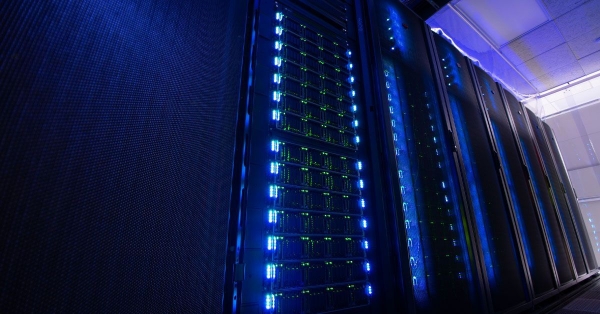
Expanse supercomputer. (Photo Credit: SDSC Communications)