

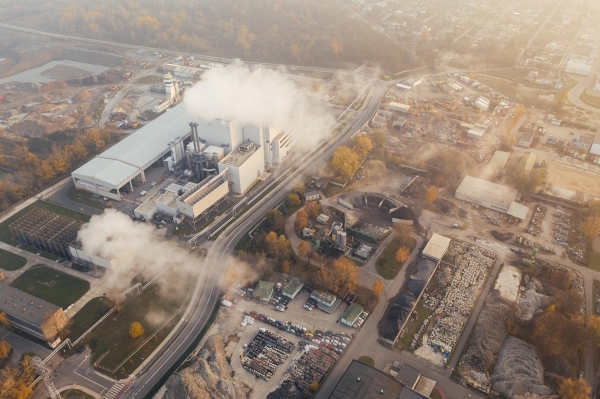
Flue gas is exhausted from home furnaces, fireplaces and even industrial plants, and it carries polluting carbon dioxide (CO2) into the atmosphere.
Flue gas is exhausted from home furnaces, fireplaces and even industrial plants, and it carries polluting carbon dioxide (CO2) into the atmosphere. To help mitigate these emissions, researchers reporting in ACS Energy Letters have designed a specialized electrode that captures airborne CO2 and directly converts it into a useful chemical material called formic acid. The system performed better than existing electrodes in tests with simulated flue gas and at ambient CO2 concentrations.
“This work shows that carbon capture and conversion do not need to be treated as separate steps. By integrating both functions into a single electrode, we demonstrate a simpler pathway for CO2 utilization under realistic gas conditions,” explains Wonyong Choi, a corresponding author on the study.
Capturing CO2 from the air should be relatively simple — after all, plants do it all the time. But converting the gas into something useful is difficult, and it is a crucial step in ensuring that carbon capture methods are widely implemented. In industrial emissions like flue gas, CO2 is often diluted amid other gases such as nitrogen and oxygen. However, existing conversion methods require highly concentrated CO2 that’s already separated from other gases to function efficiently. So, Donglai Pan, Myoung Hwan Oh, Wonyong Choi and colleagues wanted to design a carbon capture and conversion system that functioned in conditions consistent with real-world flue gas and could convert even small amounts of captured CO2 into a useful product.
Read More: American Chemical Society
Photo Credit: marcinjozwiak via Pixabay


