

The first study from GreenDrill—an ambitious project to recover rock samples buried thousands of feet beneath the Greenland Ice Sheet—finds that Greenland’s Prudhoe Dome ice cap had fully melted around 7,000 years ago, much more recently than previously thought.
The first study from GreenDrill—an ambitious project to recover rock samples buried thousands of feet beneath the Greenland Ice Sheet—finds that Greenland’s Prudhoe Dome ice cap had fully melted around 7,000 years ago, much more recently than previously thought. This research, co-led by Columbia University and the University at Buffalo, is intended to assess how sensitive Greenland’s ice is to climate change.
Published in Nature Geoscience, the findings suggest that the Prudhoe Dome, an ice dome in northwestern Greenland about 1,700 feet thick covering 965 square miles, is highly sensitive to the relatively mild temperatures of the Holocene, the interglacial period that began 11,000 years ago and continues today.
“The Holocene is a time known for climate stability, when humans first began developing farming practices and taking steps toward civilization,” says University at Buffalo’s Jason Briner, who co-leads the GreenDrill project. “If natural, mild climate change of that era melted Prudhoe Dome and kept it retreated for potentially thousands of years, it may only be a matter of time before it begins peeling back again from today’s human-induced climate change,”
Read more at: Columbia Climate School
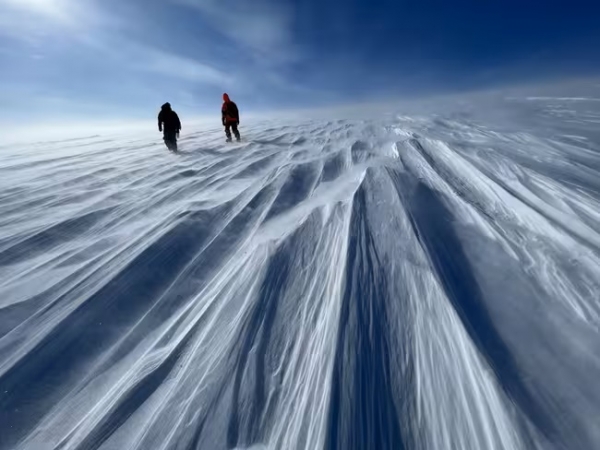
GreenDrill team members at Prudhoe Dome, a key ice cap part of the Greenland Ice Sheet. The project’s first study shows this ice cap was gone 7,000 years ago. (Photo Credit: Jason Briner/University at Buffalo)


