

In a ferromagnet, combined forces are at work. In order for a compass needle to point north or a fridge magnet to stick to the fridge door, countless electron spins inside them, each of which only creates a tiny magnetic field, all need to line up in the same direction.
In a ferromagnet, combined forces are at work. In order for a compass needle to point north or a fridge magnet to stick to the fridge door, countless electron spins inside them, each of which only creates a tiny magnetic field, all need to line up in the same direction. This happens through interactions between the spins, which have to be stronger than the disordered thermal motion inside the ferromagnet. If the temperature of the material is below a critical value, it becomes ferromagnetic.
Conversely, to change the polarity of a ferromagnet, one usually needs to first heat it up above its critical temperature. The electron spins can then reorient themselves, and after cooling down, the magnetic field of the ferromagnet eventually points in a different direction.
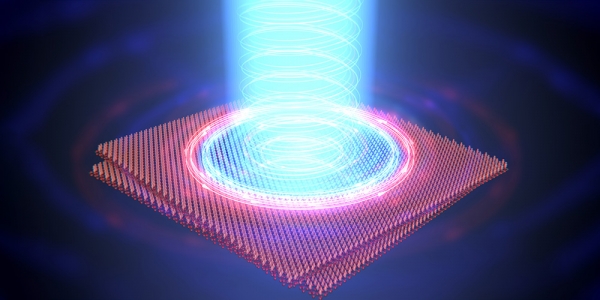
A team of researchers led by Prof. Dr. Tomasz Smoleński at the University of Basel and Prof. Dr. Ataç Imamoğlu at the ETH in Zurich have now managed to bring about such a re-orientation using only light – without any heating. They recently published their results in the scientific journal Nature.
Read more at: University of Basel
The researchers used a laser pulse (blue) to change the polarity of a ferromagnetic state in a special material consisting of twisted atomic layers (red). (Photo Credit: Enrique Sahagún, Scixel / University of Basel, Department of Physics)


