Global climate models capture many of the processes that shape Earth’s weather and climate.
Global climate models capture many of the processes that shape Earth’s weather and climate. Based on physics, chemistry, fluid motion, and observed data, hundreds of these models agree that more carbon dioxide in the atmosphere leads to hotter global temperatures and more extreme weather.
Still, uncertainty remains around how seasonal weather patterns and atmospheric systems like the jet stream will respond to global warming. Some of this uncertainty stems from the way models approximate the effects of relatively short-lived, small-scale phenomena known as gravity waves.
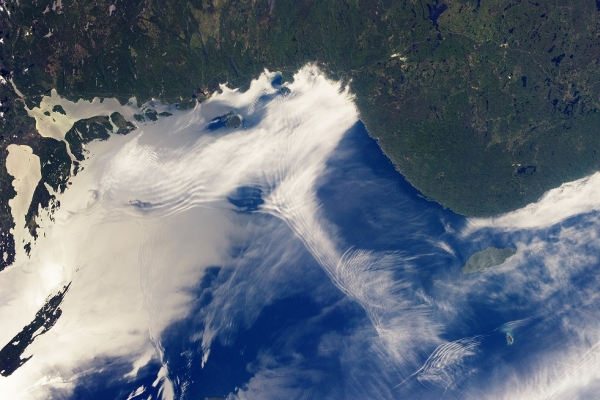
Unlike gravitational waves, which distort the fabric of space-time, atmospheric gravity waves form around strong convective storms or when a pocket of air hits a mountain or other obstacle. The pocket moves up until it becomes denser than the surrounding air, then sinks back down. Like a pebble dropped into a pond, that sinking air creates a ripple outward.
Read More: Stanford University
Gravity waves can produce parallel bands of clouds, as seen in this 2013 view of Lake Superior from the International Space Station. (Photo Credit: ISS Crew Earth Observations experiment and Image Science & Analysis Laboratory, Johnson Space Center)