

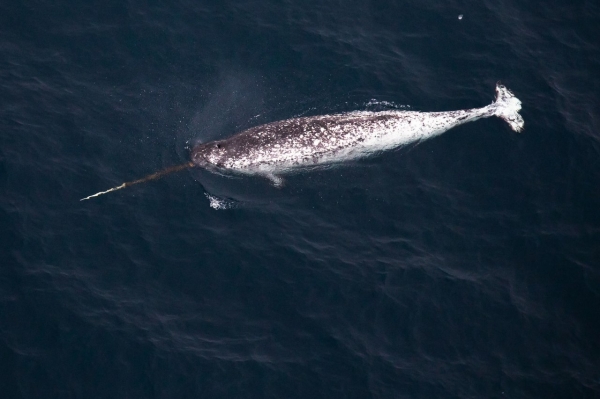
In a warming Arctic, noise from growing shipping traffic is interfering with the ability of narwhals to hunt and communicate.
In a warming Arctic, noise from growing shipping traffic is interfering with the ability of narwhals to hunt and communicate.
For most of their evolutionary history, narwhals have relied more on sound than sight to survive in the Arctic’s dark icy waters.
The speckled toothed whales — sometimes referred to as “unicorns of the sea” for the long, spiral tusks that protrude from the heads of males — navigate, hunt, and communicate using echolocation. By emitting a series of calls, whistles, and high frequency clicks — as many as a thousand per second — and listening for the echoes that bounce back, they are able to locate prey hundreds to thousands of feet deep and detect narrow cracks in sea ice where they can surface to breathe.
But as global temperatures continue to rise, the acoustic world narwhals depend on is rapidly shifting throughout their range, from northeastern Canada and Greenland to Norway’s Svalbard archipelago and Arctic waters in Russia. It’s getting louder.
Read More: Yale Environment 360
Photo Credit: пресс-служба ПАО "Газпром нефть via Wikimedia Commons



