

A new smart platform invented by Purdue University researchers to wirelessly monitor subsoil health could change the landscape of agricultural sensing systems.
A new smart platform invented by Purdue University researchers to wirelessly monitor subsoil health could change the landscape of agricultural sensing systems.
The invention addresses a critical need in agriculture nationwide: the efficient use of water, fertilizers and pesticides. Due to the variability of soil conditions across large fields, applying uniform amounts of these inputs can lead to significant waste, increasing costs for farmers and causing environmental harm if nutrient runoff reaches water systems.
“Our technology enables wide-area monitoring of subsoil conditions, helping farmers apply the right amount of inputs where and when they’re truly needed,” said Rahim Rahimi, an associate professor in Purdue’s School of Materials Engineering, who led development of the system. “This not only reduces environmental impact, but also improves crop yields and lowers operational costs, ultimately making food production more sustainable and affordable.”
Read more at: Purdue University
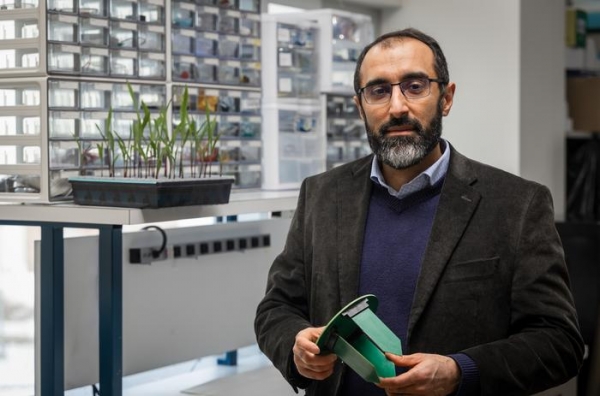
A team led by Purdue University associate professor Rahim Rahimi has invented a system that uses nail-shaped sensing probes to deliver deeper insights on subsoil conditions to farmers. (Photo Credit: Purdue University photo/Kevin Crisp)


