Geologic reservoirs that trapped petroleum for millions of years are now being repurposed to store the greenhouse gas carbon dioxide.
Geologic reservoirs that trapped petroleum for millions of years are now being repurposed to store the greenhouse gas carbon dioxide. New research is improving how we monitor this storage and verify how much CO₂ these reservoirs have stored.
As Norway and other nations begin to scale up the storage of CO2 in undersea geologic reservoirs, NTNU research is helping answer two important questions about this storage.
“Where has my CO2 gone? Is it leaking or not?” says Martin Landrø, an NTNU geophysicist and director of the university’s Centre for Geophysical Forecasting. “Those are the basic questions actually.”
Read more at: Norwegian University of Science and Technology
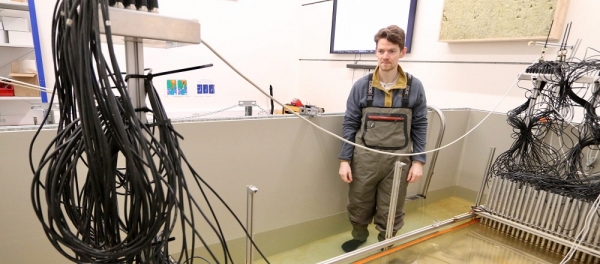
Kasper Hunnestad explains how he can move the racks with ultrasonic sensors over the mockup of the Utsira formation to simulate the way seismic surveys are conducted out in the ocean. The ultrasonic sensors are in the tall metal pipes to the left of the photo. (Photo Credit: Nancy Bazilchuk, NTNU)