

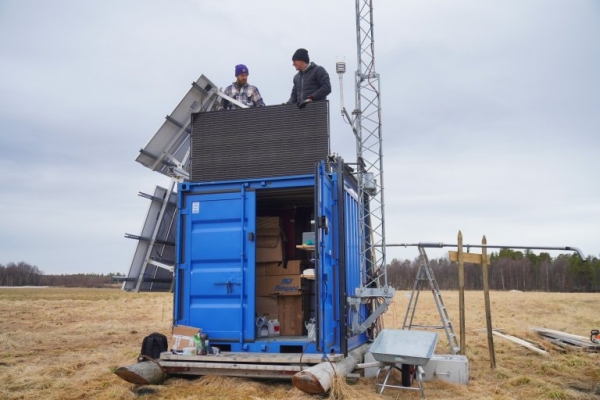
A two year field experiment carried out in the world’s northernmost cultivated peatland, located in Pasvik in Finnmark, shows that greenhouse gas emissions can be greatly reduced by raising and maintaining the water table at 25–50 centimetres below the soil surface.
A two year field experiment carried out in the world’s northernmost cultivated peatland, located in Pasvik in Finnmark, shows that greenhouse gas emissions can be greatly reduced by raising and maintaining the water table at 25–50 centimetres below the soil surface.
In its natural state, peatland is one of the largest carbon stores in nature. This is because the soil is so waterlogged and low in oxygen that dead plant material breaks down very slowly. The plants do not fully decompose but instead accumulate over thousands of years, forming thick layers of peat.
When a peatland is drained for agricultural use, the water level drops and oxygen enters the peat layer. Microorganisms can then break down the old plant material much faster, releasing carbon that has been stored for many years as the greenhouse gas carbon dioxide (CO₂).
Read More: Norwegian Institute of Bioeconomy Research
Image: David Kniha (left) and Mikhail Mastepanov installing equipment for the field experiment in Pasvik. (Photo: Junbin Zhao)


