

How a shifting plate boundary and hot mantle material formed one of the largest canyons in the ocean.
How a shifting plate boundary and hot mantle material formed one of the largest canyons in the ocean.
The King’s Trough Complex is a several-hundred-kilometre-long, canyon-like system of trenches on the North Atlantic seafloor. Its formation was long thought to be the result of simple stretching of the oceanic crust. An international research team led by the GEOMAR Helmholtz Centre for Ocean Research Kiel has now shown that the so-called “Grand Canyon of the Atlantic” was formed around 37 to 24 million years ago through the interplay of a temporarily existing plate boundary and an early branch of the Azores mantle plume. Their findings have been published in the AGU journal Geochemistry, Geophysics, Geosystems (G-Cubed).
Deep canyons on land, such as the Grand Canyon, are typically carved by the erosive power of flowing water. No comparable process occurs in the ocean. Yet there are structures underwater that exceed even the largest terrestrial canyons in size. One such colossal submarine canyon lies roughly 1,000 kilometres off the coast of Portugal: The King’s Trough Complex. It comprises a system of parallel trenches and deep basins extending some 500 kilometres. At its eastern end, Peake Deep represents one of the deepest points in the Atlantic Ocean.
Read More: Helmholtz Centre for Ocean Research Kiel (GEOMAR)
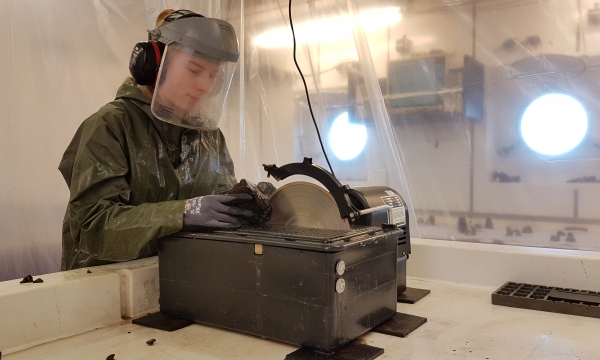
Image: Volcanic rock acts as an archive of Earth's history. Here, a scientist on board the METEOR cuts through a rock sample recovered from King's Trough. (Credit: Photo: Fabian Hampel, GEOMAR)


