While artificial intelligence has ushered in a new era of more accurate weather forecasting, A.I. models may still struggle to predict freak storms.
While artificial intelligence has ushered in a new era of more accurate weather forecasting, A.I. models may still struggle to predict freak storms. This week a historic blizzard blanketed the Northeast in snow, dumping more than 2 feet on parts of New York and Massachusetts, and a conventional weather model outperformed A.I. models in accurately predicting the storm.
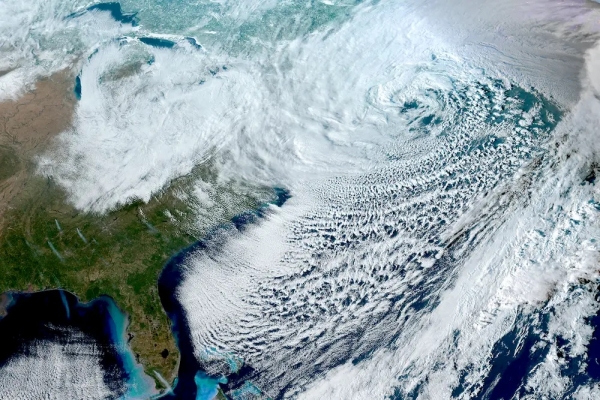
The blizzard was a nor’easter, a winter cyclone known to spin up quickly when cold air over land collides with warm ocean currents brought northward by the Gulf Stream. The Global Forecast System, a conventional U.S. weather model, warned of heavy snowfall several days in advance, while newer A.I. weather models were less certain, Bloomberg reported. In the end, the blizzard dumped 20 inches of snow on New York’s Central Park, making it the ninth biggest snowstorm ever to hit Manhattan.
While A.I. weather models often outperform conventional models, producing more detailed forecasts that look farther into the future, they may stumble in forecasting extreme weather. That’s because A.I. systems learn to make predictions by identifying patterns in historical weather data. Research shows that A.I. models may fail to predict storms that have little precedent in the weather record, a problem that could become more acute in the years ahead as warming fuels ever more extreme weather.
Read more at: Yale Environment 360
A blizzard descends on the Northeast U.S. on Tuesday, February 23. (Photo Credit: NOAA / CIRA)