

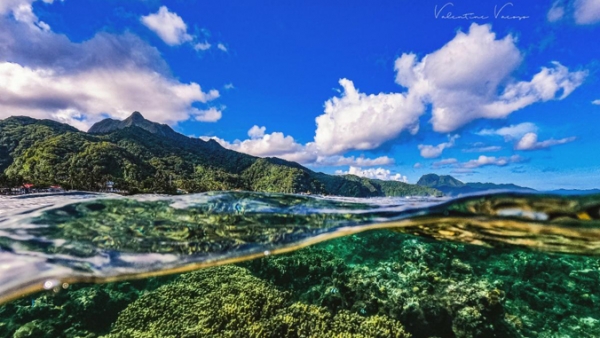
A new $4.6–million multi-institute collaborative project to help grow coral restoration capacity in American Samoa will begin in early 2026, leveraging more than two decades of coral heat tolerance studies to inform a restoration with resilience approach.
A new $4.6–million multi-institute collaborative project to help grow coral restoration capacity in American Samoa will begin in early 2026, leveraging more than two decades of coral heat tolerance studies to inform a restoration with resilience approach.
The project will bring together partners from American Samoa Community College, University of Hawaiʻi Sea Grant College Program, American Samoa Department of Marine and Wildlife Resources, UH Mānoa and Old Dominion University with local agencies and village leaders to focus on restoring healthy coral reefs and training the next generation of natural resource managers.
American Samoa has some of the healthiest coral reefs within inhabited U.S. waters that are exceptionally heat tolerant, as well as the world’s oldest continuously monitored coral reef transect, making it an excellent coral reef study site. American Samoa also has the highest rate of relative sea-level rise recorded within the NOAA global tide gauge network. Since the fringing reef crests (the shallow part of the reef where the waves break) remove up to 97% of wave energy before reaching the shore, maintaining healthy reefs is key to protecting the land. Coral restoration, where corals are grown and outplanted onto the reef, is one method of helping reefs recover from impacts such as storms and ship groundings.
Read More at: University of Hawaii
Photo Credit: Valentine Vaeoso


