The study, published today (30 March), was led by Dr Adriana Humanes, Newcastle University and Dr Juan Ortiz, Australian Institute of Marine Science (AIMS).
The study, published today (30 March), was led by Dr Adriana Humanes, Newcastle University and Dr Juan Ortiz, Australian Institute of Marine Science (AIMS). It highlights fundamental changes needed to generate knowledge fast enough to make these methods effective.
The international team of 28 experts identified promising discoveries that highlight the potential of assisted evolution to help mitigate the impact of climate change in reefs.
Assisted evolution aims to accelerate natural adaptation rates to help corals increase their thermal tolerance and reduce mortality during marine heat waves. Over the past decades multiple knowledge breakthroughs have increased our understanding of the processes driving thermal tolerance in corals. However, the experts’ evaluation of progress warns that the current rate of research and development of coral assisted evolution methods is likely to be outpaced by rapidly warming climate.
Read More at: Newcastle University
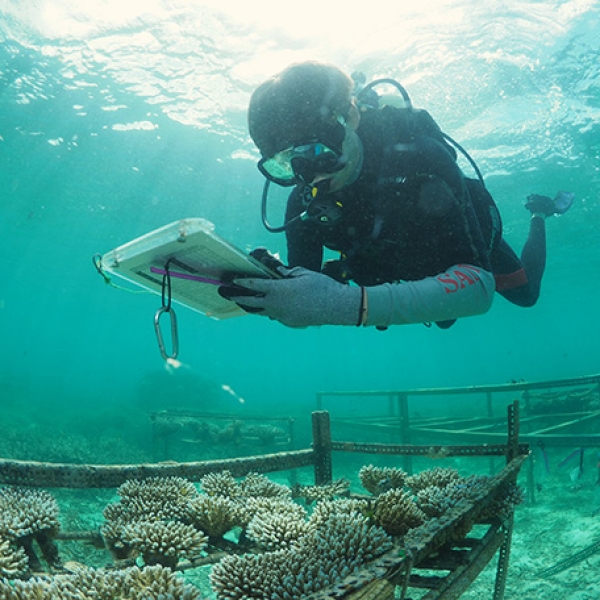
One of study authors monitoring corals they selectively bred for high heat tolerance at an ocean nursery in Palau. (Photo Credit: Dr James Guest)